

ELLIS Unit Madrid: Forging Interpretable and Causal AI for for Health, Environment, and Network Systems
Mission & Vision
ELLIS Unit Madrid aims to drive innovative and interpretable AI research that addresses real-world challenges. Bringing together leading researchers from Madrid’s public universities, the Unit fosters collaboration, creativity, and talent development across disciplines. By connecting with the broader ELLIS network, it seeks to advance intelligent and sustainable technologies with impact in areas such as healthcare, climate, energy, robotics, and mobility.
The Unit is particularly committed to advancing fundamental knowledge in interpretable, probabilistic, and causal machine learning, while also exploring emerging directions such as quantum technologies for intelligent systems. Its long-term vision is to strengthen Madrid as a major European AI hub, while contributing to the development of reliable, human-relevant, and scientifically grounded AI.
The motivation behind the Unit is clear: to connect Madrid’s distributed AI excellence into a shared research community capable of tackling both foundational and application-driven challenges.
Key Numbers & Achievements
Establishing the ELLIS Unit Madrid enables researchers from all public universities in the region to connect with one of Europe’s leading AI research networks. Since its creation in June 2022, the Unit has grown steadily, bringing together an expanding community of researchers and becoming a vibrant hub for knowledge exchange through workshops, joint publications, and active participation in international conferences.
27 Members
5 Fellows:
Pedro Larrañaga (Universidad Politécnica de Madrid)
Concha Bielza (Universidad Politécnica de Madrid)
Julián Fiérrez (Universidad Autónoma de Madrid)
Miguel Ángel Martín-Delgado (Universidad Complutense de Madrid)
Sancho Salcedo-Sanz (Universidad de Alcalá)
1 Scholar
Dan Casas (Universidad Rey Juan Carlos)
2 ELLIS PhD Students
Onno Niemann (Universidad Autónoma de Madrid)
María Fernanda Alcalá Durand (Universidad Politécnica de Madrid)
ELLIS Unit Madrid plays an active role in strengthening and expanding Madrid’s AI ecosystem through the organisation of scientific events, workshops, outreach initiatives, and collaborations with industry and public institutions. Beyond its research activity, the Unit has become a visible meeting point for researchers, students, companies, and stakeholders interested in the future of artificial intelligence, helping position Madrid as a dynamic hub for AI innovation and knowledge exchange. Members of the Unit regularly co-organise and sponsor conferences, promote workshops for students and early-career researchers, and foster dialogue between academia and industry around the societal impact and applications of AI.
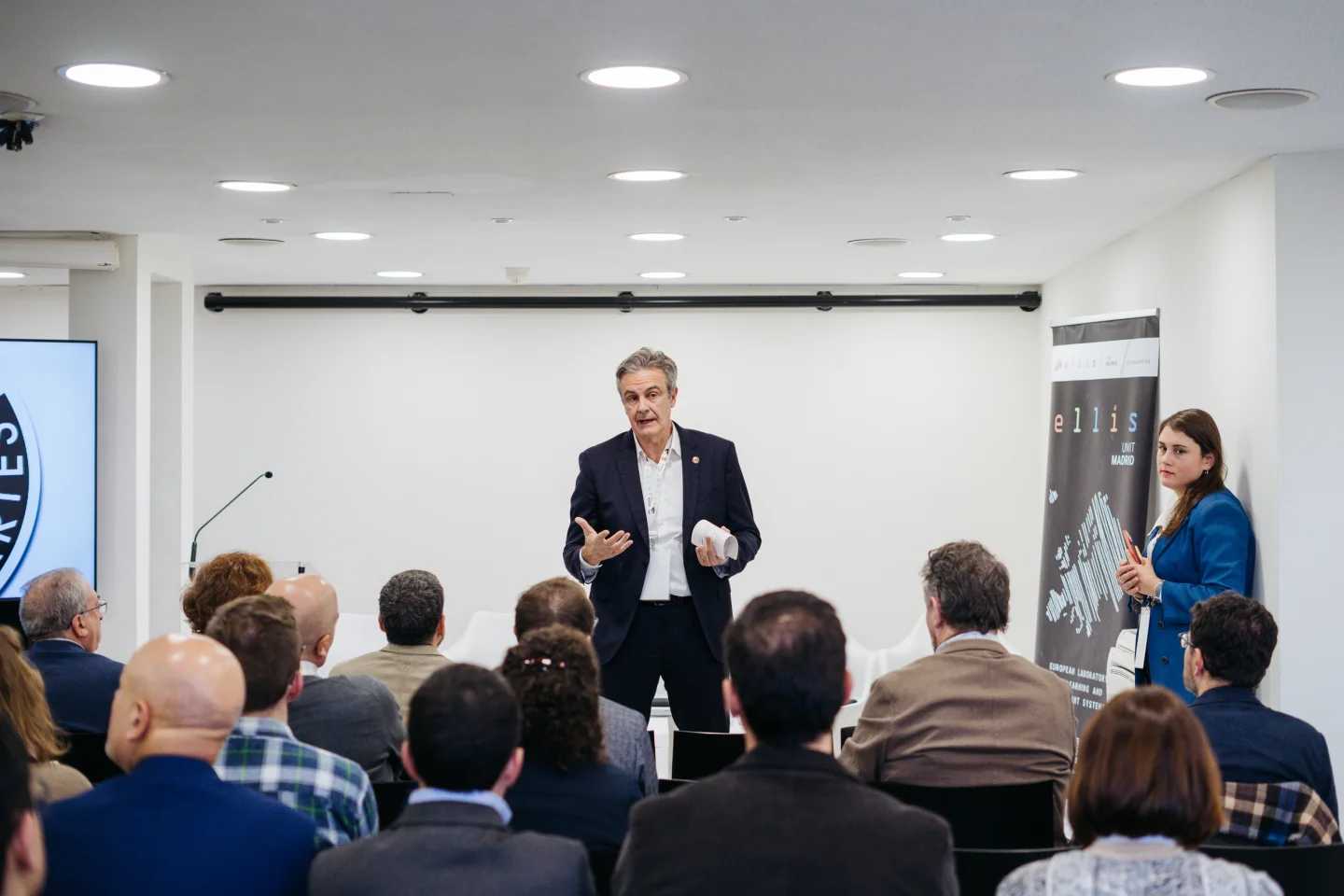
A key milestone in these efforts was the organisation of IA Conecta 2024, held in December 2024 at the Círculo de Bellas Artes in Madrid. The event brought together ELLIS researchers, academic experts, and industry representatives to promote collaboration and exchange best practices in artificial intelligence. Through panel discussions addressing topics such as ethics, education, economy, healthcare, and industry, IA Conecta reinforced the Unit’s commitment to bridging cutting-edge research with real-world applications.
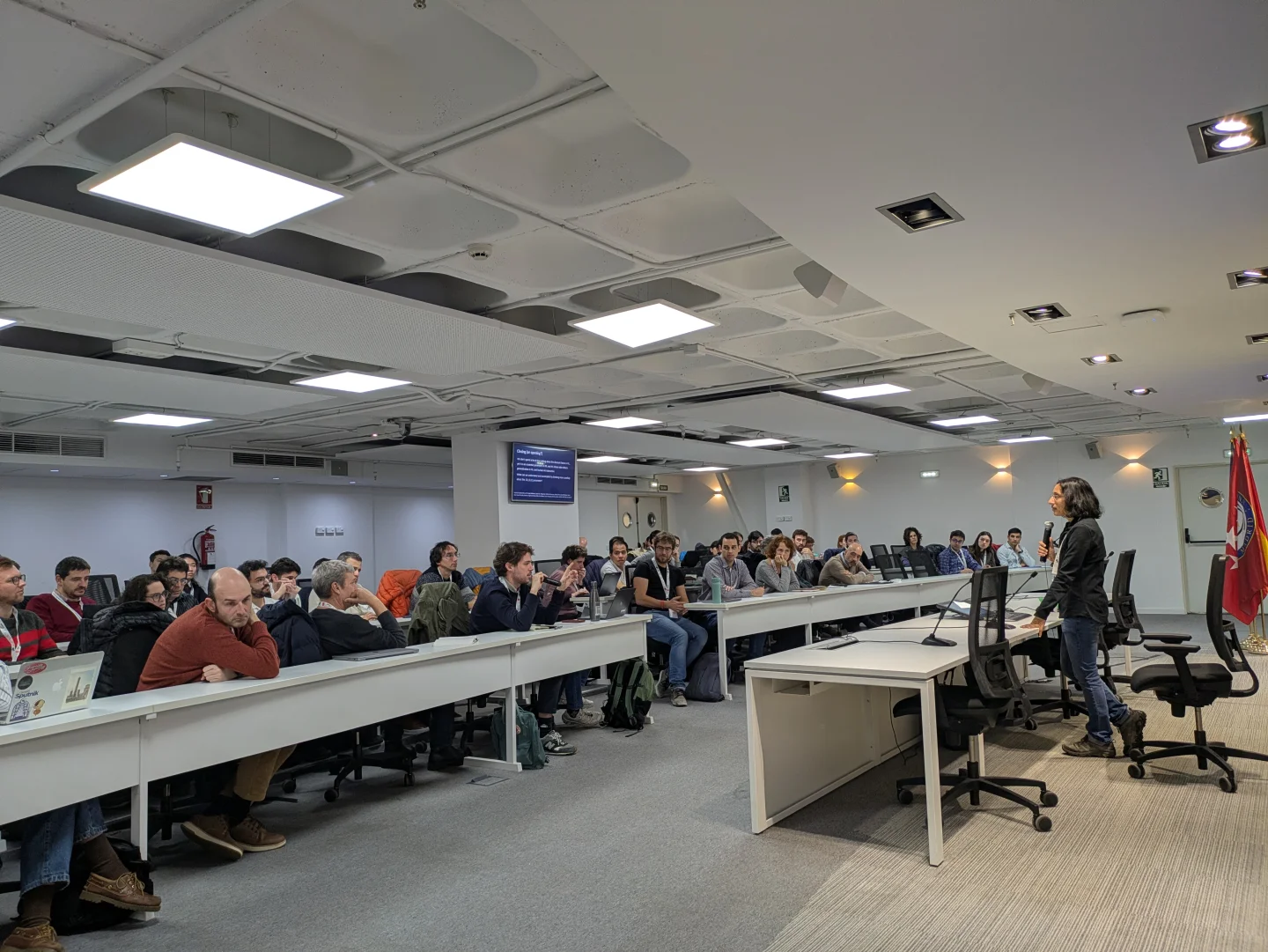
In December 2025, the Unit further strengthened its community-building activities by organising the “Bright Minds, Cold Days” Workshop, which gathered more than 70 researchers and students from Madrid’s public universities. The event featured invited talks by Finale Doshi-Velez from Harvard University and Fernando Pérez-Cruz from ETH Zurich, addressing key challenges in reinforcement learning and foundation models for macroeconomic forecasting. The workshop also included a poster session, creating a vibrant environment for scientific discussion and collaboration across institutions and research areas.
The creation of ELLIS Unit Madrid reflects a shared ambition to strengthen collaboration across institutions and position Madrid as a key player in the European AI landscape. As Antonio Artés-Rodríguez, Co-Director of ELLIS Unit Madrid and Professor at Universidad Carlos III de Madrid (UC3M), explains:
ELLIS Unit Madrid was established with the primary goal of driving excellence in fundamental machine learning research. Our mission is to consolidate a meeting point in Madrid that, following the ELLIS spirit, connects the talent of public universities to elevate the quality and international visibility of European AI research.
This vision is closely aligned with the broader opportunities offered by the ELLIS network. For Antonio G. Marqués, Co-Director of ELLIS Unit Madrid and Professor at Universidad Rey Juan Carlos (URJC), being part of ELLIS represents a key step towards deeper international integration.
Establishing an ELLIS node in Madrid allows us to become part of one of the most vibrant and forward-looking AI research communities in Europe. Co-supervising ELLIS PhD students opens the door to truly international collaboration, enabling us to share best practices, foster excellence, and collectively elevate the quality and impact of European AI research.
Research Areas
ELLIS Unit Madrid builds its research on a strong interdisciplinary foundation, combining theoretical advances in probabilistic and causal machine learning with experimental and applied studies in diverse domains. By integrating expertise from computer science, mathematics, engineering, and the natural sciences, the Unit develops interpretable and reliable AI methods for dynamic and complex systems.
Its main research areas include:
Probabilistic, interpretable, and causal machine learning, with a focus on reliable methods for dynamic scenarios and complex decision-making.
Healthcare and biomedical AI, including machine learning for medical signal processing, clinical decision support, mental health, neuroscience, and patient monitoring.
Graph-based machine learning and network intelligence, including graph signal processing, graph learning, optimization over graphs, graph diffusion models, and reinforcement learning over graphs.
Biometrics and human-centred AI, spanning pattern recognition, identity technologies, human-computer interaction, and deepfake analysis.
Robotics, intelligent transportation, and autonomous systems, with applications in road safety, mobility, and service robotics.
Computer vision and multimedia understanding, including image and video analysis, explainable AI, and intelligent perception systems.
AI for energy, climate, and remote sensing, including environmental monitoring, Earth and climate sciences, and sustainable systems.
Cross-cutting quantum technologies for intelligent systems, connecting emerging computational paradigms with AI research.
Together, these lines of work create a vibrant ecosystem in which foundational research and practical impact reinforce one another.
Research Highlights
ELLIS Unit Madrid brings together strong expertise in foundational machine learning and high-impact AI applications across healthcare, biometrics, computer vision, robotics, energy, climate, and network science. Its research activity spans probabilistic and Bayesian machine learning, graph-based learning, trustworthy AI, and domain-driven intelligent systems, with contributions regularly published at leading AI and signal processing venues. Recent highlights across this broad portfolio include advances in probabilistic inference, graph-based learning, Bayesian deep learning, and AI for healthcare.
Recent advances in probabilistic machine learning include Improved Variational Inference in Discrete VAEs using Error Correcting Codes (UAI 2025), co-authored by ELLIS Unit Madrid member Pablo M. Olmos. The work introduces a novel approach to discrete variational inference based on error-correcting codes, improving generation quality, reconstruction accuracy, and uncertainty calibration. It was also presented at the ELLIS UnConference 2025, reflecting its relevance within the broader ELLIS community.
A second representative line is graph-based machine learning and graph signal processing. Recent contributions from the group led by ELLIS Unit Madrid Co-Director Antonio G. Marques include Bayesian graph learning from nodal observations (AISTATS 2024), fair graph learning (NeurIPS 2024), graphon estimation (NeurIPS 2025), and graph convolutional neural networks, the latter recognized with a 2024 IEEE Signal Processing Society Best Paper Award.
Another illustrative contribution in Bayesian deep learning is Variational Linearized Laplace Approximation for Bayesian Deep Learning (ICML 2024), co-authored by ELLIS Unit Madrid member Daniel Hernández-Lobato. The paper proposes a scalable method for uncertainty estimation in deep neural networks using variational sparse Gaussian processes, strengthening the Unit’s research portfolio in reliable and uncertainty-aware machine learning.
ELLIS Unit Madrid further demonstrates strong impact in AI for healthcare, particularly in speech-based biomarkers for Parkinson’s disease. This line of work has been featured in invited and plenary talks at international venues including the Harvard–MIT Speech Biomarker Group (2024), Iberspeech 2024, and the Digital Mental Health and Wellbeing Conference (2025). It is further supported by leadership in the organization of scientific events, such as the 2nd Automatic Assessment of Parkinsonian Speech Workshop in Cambridge, USA, in 2024.
More recently, the Unit has contributed to advances in explainable AI through the work Optimal Transport Group Counterfactual Explanations (ICML 2026), co-authored by Enrique Valero-Leal, Bernd Bischl, Pedro Larrañaga, Concha Bielza, and Giuseppe Casalicchio, in collaboration with ELLIS Unit Munich. The paper introduces a novel framework for group counterfactual explanations based on optimal transport, enabling the generation of counterfactual instances that generalise to new data points without re-optimisation while preserving group structure. By learning an explicit transport map that minimizes total transport cost, the approach improves interpretability and stability compared to existing methods, and provides theoretical insights into the underlying optimisation problems.
Additional recent contributions further reinforce the Unit’s activity in probabilistic modelling and generative AI. Notably, the paper Revisiting Nonstationary Kernel Design for Multi-Output Gaussian Processes (ICLR 2026), co-authored by Qiaochu Xu, Zi Yang, Ying Li, Michael Minyi Zhang, and Pablo M. Olmos, revisits kernel design in multi-output Gaussian processes, advancing modelling capabilities for complex, nonstationary data. In parallel, A Probabilistic Hard Concept Bottleneck for Steerable Generative Models (ICLR 2026), co-authored by María Martínez-García, Ricardo Vázquez Álvarez, Alejandro Lancho, Pablo M. Olmos, and Isabel Valera, introduces a probabilistic framework to improve interpretability and controllability in generative models through structured concept representations.
Further advances in probabilistic inference are reflected in Explicit Density Approximation for Neural Implicit Samplers Using a Bernstein-Based Convex Divergence (AISTATS 2026, Spotlight), co-authored by José Manuel de Frutos, Pablo M. Olmos, Manuel A. Vázquez, and Joaquín Míguez. This work proposes a novel approach for density estimation in neural implicit models, enabling more accurate and theoretically grounded approximations. Its selection as a Spotlight presentation highlights the impact and relevance of this contribution within the statistical machine learning community.
Beyond individual publications, members of ELLIS Unit Madrid actively contribute to the international research ecosystem through the organization of conferences and workshops, invited and plenary talks, and participation in cross-unit collaborations. These activities reinforce the Unit’s role as a visible and connected hub for AI research in Spain and within the broader ELLIS network.
Ongoing Research Projects
ELLIS Unit Madrid is actively involved in a diverse set of research projects spanning foundational machine learning, quantum AI, healthcare applications, and interdisciplinary collaborations with leading European and international institutions. These projects reflect the Unit’s commitment to advancing both theoretical and applied AI, while fostering strong academic and cross-border partnerships.
MLCARE: AI for personalized medicine (UC3M – 22 European Institutions collaboration)
Coordinated by Prof. Pablo M. Olmos, MLCARE (HORIZON-MSCA-2024-DN) is a European Doctoral Network aimed at transforming personalized medicine through advanced AI. The project integrates genomic, clinical, and environmental data into multimodal patient profiles using Foundation Models and generative AI. In addition to its research objectives, MLCARE trains 14 doctoral candidates in AI, computational biology, and healthcare, contributing to the development of trustworthy, explainable, and secure AI systems for precision medicine.CARE-CM: Generalist Medical AI for suicide risk assessment (UC3M – Comunidad de Madrid)
Led by Prof. Antonio Artés, Director of ELLIS Unit Madrid, CARE-CM (2025–2028) is a synergistic R&D project funded by the Comunidad de Madrid. The project aims to develop a Generalist Medical AI (GMAI) model for assessing and managing suicide risk by integrating electronic health records, digital phenotype, and exposome data. It focuses on the development of deep learning–based foundational models for time-series data, as well as data fusion algorithms to generate explainable digital biomarkers that support clinical decision-making. The approach will be validated through both retrospective and prospective observational studies, ensuring its applicability in real-world suicide prevention strategies.Near-perfect classification of stochastic processes (UAM)
Led by Prof. Alberto Suárez, this line of work focuses on the near-perfect classification of Gaussian and second-order stochastic processes, as well as solutions of stochastic differential equations. The research is conducted in collaboration with leading European institutions, including Université Paris Sorbonne, Université Paris Dauphine, Université de Nantes, and Université Paris 1 Panthéon-Sorbonne, strengthening theoretical advances in statistical learning and stochastic modelling.Generative AI for molecular physics (UAM – ELLIS Cambridge collaboration)
This project explores the application of generative AI methods to molecular physics, in collaboration with Prof. José Miguel Hernández-Lobato (ELLIS Unit Cambridge, University of Cambridge). It aims to bridge machine learning and physical sciences, contributing to the development of new AI-driven approaches for modelling complex molecular systems.KetQC: Key Enabling Technologies for Quantum Computing (UCM)
Led by Prof. Miguel Ángel Martín-Delgado at Universidad Complutense de Madrid, this national project develops quantum algorithms for artificial intelligence alongside classical AI methods for quantum error correction. The project connects quantum learning, quantum Bayesian inference, and fault-tolerant quantum computing, advancing research at the intersection of AI and quantum technologies.AI for Parkinson’s disease screening and monitoring (UPM – Hospital Gregorio Marañón)
Several projects led by Prof. Juan Ignacio Godino Llorente focus on the development of AI-based methods for the diagnosis and monitoring of Parkinson’s disease. These include the PD-RADAR project, which leverages radar-based biometrics for screening and monitoring, and the DEPIA project, which integrates motor and non-motor biomarkers for diagnosis and evaluation. Both projects are funded by the Spanish State Research Agency and conducted in collaboration with Hospital Gregorio Marañón.Speech-based biomarkers for neurodegenerative diseases (UPM – MIT collaboration)
This project develops methods for the automatic identification of speech landmarks to assess neurodegenerative diseases. Funded by the MISTI Global Seed Funds and carried out in collaboration with the Massachusetts Institute of Technology (MIT), it explores the use of speech as a non-invasive biomarker for early diagnosis and monitoring.

Collaborating across ELLIS
ELLIS Unit Madrid actively collaborates with several ELLIS Units and Fellows across Europe, strengthening its role within the network through joint research, mobility initiatives, and interdisciplinary projects.
Collaboration with ELLIS Unit Cambridge (UK)
Researchers from the Unit, including Prof. Alberto Suárez (UAM), collaborate with Prof. José Miguel Hernández-Lobato (ELLIS Unit Cambridge) on the application of generative AI methods to molecular physics, bridging machine learning and the physical sciences.Collaboration with ELLIS Unit Lisbon (Portugal)
The ByO research group maintains an active collaboration with the Lisbon ELLIS Unit. As part of this partnership, ELLIS PhD student M. Fernanda Alcalá will carry out a research stay at INESC-ID under the supervision of Alberto Abad, fostering knowledge exchange and joint research activities.Collaboration with ELLIS Unit Munich (Germany)
Members of the Unit collaborate with Prof. Xiaoxiang Zhu (ELLIS Fellow, Technical University of Munich) on topics related to machine learning for Earth and climate sciences, contributing to the development of AI methods for environmental and geospatial applications.Collaboration with ELLIS Unit Delft (The Netherlands)
The Unit has a sustained collaboration with ELLIS Unit Delft, especially with Prof. Elvin Isufi and TU Delft researchers such as Prof. Geert Leus. Joint work spans graph-based machine learning and signal processing, including graph neural networks, dynamic network tracking, simplicial-complex learning, and matched topological subspace detection. These collaborations have led to paper awards and joint organization of scientific workshops and conferences.Collaboration within the ELLIS Programme on Machine Learning for Earth and Climate Science
The Unit also engages with Prof. Gustau Camps-Valls (ELLIS Fellow, Universitat de València and Director of the ELLIS programme on Machine Learning for Earth and Climate Science), strengthening connections in the area of AI for environmental and climate-related challenges.
Support for Young Talents
ELLIS Unit Madrid is strongly committed to supporting the next generation of AI researchers. The Unit currently includes 2 ELLIS PhD students and benefits from the strong academic environments of Madrid’s six public universities.
Young researchers within the Unit are supported through mentorship, doctoral supervision, collaborative research environments, and access to a broad network of expertise spanning multiple institutions and disciplines. The Unit also contributes to the dissemination of opportunities such as summer schools, workshops, and ELLIS-related training activities, helping students and early-career researchers connect with the broader European AI community.
By bringing together researchers from different universities under a shared ELLIS framework, the Unit offers early-career scientists a uniquely rich environment in which to develop ambitious interdisciplinary research.
Efforts in Public Engagement
ELLIS Unit Madrid contributes to public engagement by making AI research visible and accessible through its website, newsletters, and outreach activities. The Unit regularly communicates achievements, new members, workshops, and research initiatives, helping build a stronger public understanding of the role of AI in science and society.
Its public-facing work also highlights the breadth of Madrid’s AI ecosystem, where public institutions and private companies collaborate to harness the technological potential of artificial intelligence. As a regional hub, the Unit helps showcase how fundamental AI research can contribute to socially relevant applications in health, mobility, climate, energy, and security.
More broadly, ELLIS Unit Madrid helps connect local excellence with European visibility, reinforcing Madrid’s role in the development of responsible, high-impact AI.
View the highlights summary:
Text written by ELLIS Unit Madrid Coordinator Patricia Tablado.