
Seven New Units Join the ELLIS Network: Czechia, Denmark, Franconia, Grenoble, NRW, Slovenia & Sweden
ELLIS Units play a foundational role in building a strong and competitive European AI research ecosystem within the ELLIS network. Their primary purpose is to create local hubs of scientific excellence where outstanding researchers can collaborate closely, exchange ideas across disciplines, and develop long-term research agendas. Rather than dispersing talent across isolated institutions, the Unit model brings leading scientists together in dedicated locations, creating critical mass in expertise, infrastructure, and mentorship.
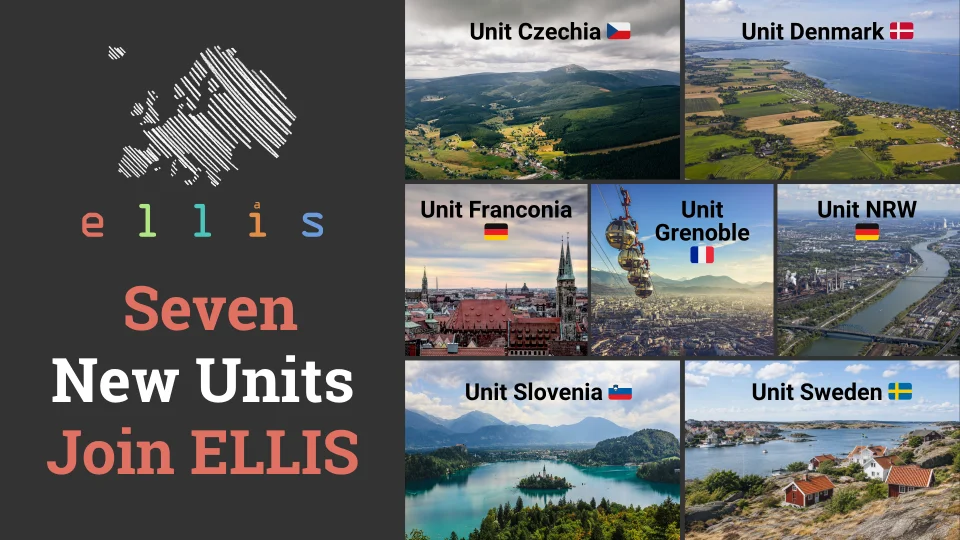
The expansion of ELLIS Units is particularly important as the network becomes increasingly interconnected across Europe. The Units in Franconia, Grenoble, and NRW, within countries already represented in the network, strengthen existing research ecosystems and broaden national collaboration by involving more institutions across each country. The Units in Slovenia and Sweden introduce new countries to the network, integrating new talent pools and research communities into ELLIS’ broader AI landscape. In addition, two Units in Czechia and Denmark have expanded from city level Units in Prague and Copenhagen, respectively, to become country level Units.
Together, this expanded geographic reach enhances collaboration across complementary areas of AI expertise, strengthens Europe’s global competitiveness, and helps ensure that cutting-edge AI research is distributed across the continent.
As Nuria Oliver, ELLIS Vice President, Director of ELLIS Alicante and member of the ELLIS Units Committee, said:
The expansion of ELLIS Units reflects a growing commitment in European research institutions to scientific excellence through top talent, collaboration and a shared vision. It embodies one of ELLIS´attributes: the power of the network, moving beyond isolation toward integrated, continent-wide scientific strength.
Welcome to our 7 New Units:
Unit Director: Josef Sivic (Czech Technical University)
Unit Coordinators: Fanny Garel (Czech Technical University) and Marcela Kamenska (Czech Technical University)
ELLIS Unit Czechia - formerly known as the ELLIS Unit Prague Unit - expanded to now integrate leading scientists in machine learning-driven fields from various research institutions across the entire country. Its research agenda encompasses a synergistic portfolio including computer vision, natural language and speech processing, robotics, and AI for life sciences. The Unit’s mission is to foster a cutting-edge research environment within the ELLIS ecosystem, establishing Czechia as a premier international hub for artificial intelligence.
Unit Director: Ole Winther (Technical University of Denmark and University of Copenhagen)
Unit Coordinator: Tine Aage (University of Copenhagen)
The core mission of ELLIS Unit Denmark is to provide excellent basic research in AI. The expansion of former ELLIS Unit Copenhagen into ELLIS Unit Denmark marks an important milestone for strengthening Denmark’s position at the international forefront of Artificial Intelligence research, innovation, and scientific collaboration across national institutions and the wider ELLIS network. By strengthening collaboration across the Danish institutions and the ELLIS network, ELLIS Unit Denmark aims to further reinforce Denmark’s position as a leading environment for AI.
Unit Directors: Radu Timofte (University of Würzburg), Wolfram Burgard (University of Technology Nuremberg), and Florian Marquardt (Friedrich-Alexander University of Erlangen-Nuremberg & Max Planck Institute for the Science of Light)
Unit Coordinators: Marianus Ifland (University of Würzburg), Daphné Kerremans (University of Technology Nuremberg), Maryam Mirzaei (Friedrich-Alexander University of Erlangen-Nuremberg)
The ELLIS Unit Franconia serves as a hub for interdisciplinary research in learning and intelligent systems, with specific expertise in medical AI, foundation models, and ethical AI. It aims to train the next generation of experts and translate research into sustainable real-world applications that benefit society.
Unit Director: Xavier Alameda-Pineda (INRIA)
Unit Coordinator: Matthieu Py (INRIA)
Specialising in multimodal learning, the Grenoble Unit focuses on core algorithmic foundations and the integration of diverse data types, such as audio, speech, and geospatial data. Its mission is to sustain an internationally leading environment for advances in computer vision, remote sensing, and robotics.
Unit Directors:
Juergen Gall (Director; University of Bonn)
Bastian Leibe (Co-Director; RWTH Aachen University)
Aleksandar Bojchevski (Co-Director; University of Cologne)
Katharina Eggensperger (Co-Director; TU Dortmund University)
Barbara Hammer (Co-Director; Bielefeld University)
Jenia Jitsev (Co-Director; Forschungszentrum Jülich)
Axel-Cyrille Ngonga Ngomo (Co-Director; Paderborn University)
Asja Fischer (Co-Director; Ruhr University Bochum)
Unit Coordinator: Marius Bock (University of Bonn)
The North Rhine-Westphalia (NRW) Unit prioritises core ML research centred on open-source generalist foundation models as fundamental machine learning artifacts with broad transferability across domains and increased trustworthiness through their fully open, reproducible nature, alongside applied ML research focused on embodied AI and agriculture. Its mission is to unify regional AI institutes into a world-class ecosystem for high-impact, open AI research.
Unit Director: Nada Lavrač (Jožef Stefan Institute)
Unit Coordinator: Vida Groznik (University of Ljubljana)
ELLIS Unit Slovenia covers a wide range of AI topics, including machine learning, explainable AI, computer vision, and language technologies. Building on Slovenia’s strong tradition in AI research, the Unit’s mission is to unite nation’s top talent to drive innovation and strengthen Europe’s position in global AI research.
Unit Director: Danica Kragic (KTH Royal Institute of Technology)
Unit Coordinator: Pierre Bodin (KTH Royal Institute of Technology)
Research at ELLIS Unit Sweden is structured around the foundations of AI, scientific discovery, and engineering applications, such as power grids and transportation. Its mission is to promote responsible AI that aligns with societal goals while strengthening strategic collaborations across the Nordic region.