
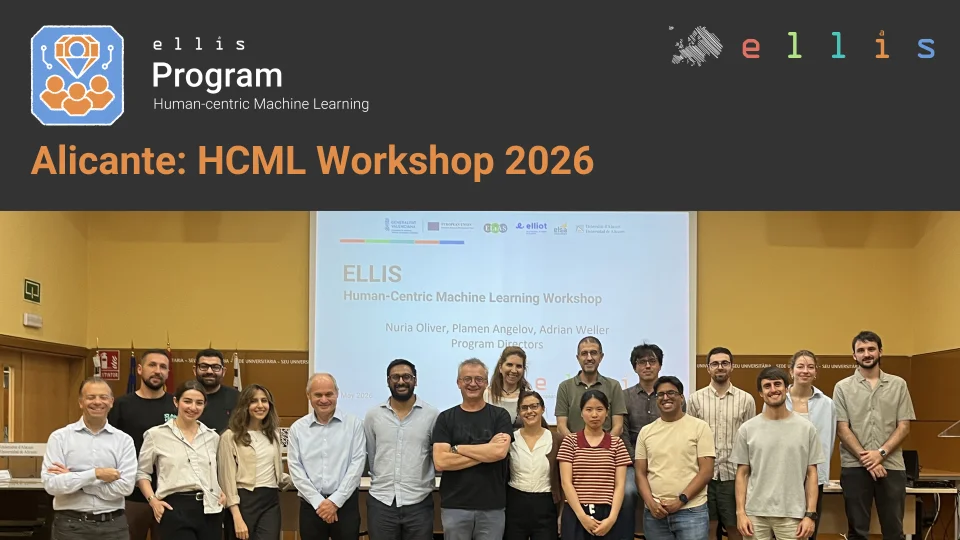
Towards Human-Centered AI: ELLIS Program HCML Workshop 2026 in Alicante
Hosted by ELLIS Unit Alicante on 27–28 May 2026, the workshop was organised by the ELLIS HCML Program Directors, Nuria Oliver (ELLIS Board Vice President, Co-Founder of ELLIS, and Director of the ELLIS Alicante Foundation) and Plamen Angelov (ELLIS Fellow, Lancaster University). The event functioned as a high-level technical forum for researchers within the European AI ecosystem.
Strategic Collaboration: ELIAS, ELLIOT, and ELSA
The workshop was a collaborative effort involving the four European projects ELIAS, ELLIOT, and ELSA. Members from these initiatives were integral to the sessions, representing a broad spectrum of research interests. Key contributors included Program Directors Nuria Oliver (ELIAS, ELLIOT, ELSA), and Plamen Angelov (ELSA), alongside Paula Helm (ELLIOT, Goethe University Frankfurt), Umang Bhatt (ELSA, University of Cambridge), and Battista Biggio (ELSA, University of Cagliari). On the technical side, important contributions also came from Diego Miguel Lozano (ELLIS Alicante, ELLIOT), Amirpasha Mozaffari, and Xuecong Liu (ELLIOT); Ioannis Sarridis, Aditya Gulati, and Adrian Arnaiz-Rodriguez (ELIAS/ELLIOT); and Elaf Almahmoud, Ariella Shulman, Mengting Wei, and Hakime Ozturk (ELSA).
May 27: AI as a Diagnostic Tool in Higher Education
The workshop commenced with a working dinner panel focused on AI in Higher Education, featuring University of Alicante professors Cristina Cachero, David Tomás, and Victoria Roca. A primary takeaway was the conceptualisation of AI-as-diagnostic: the ability of Large Language Models (LLMs) to complete academic tasks serves as a metric for the obsolescence of current assessment frameworks. The panel concluded that institutions require a structural redesign of learning objectives rather than mere pedagogical adjustments.
May 28: Technical Deep Dives and Emerging Research
Day two focused on the theoretical and empirical foundations of human-centric systems, introduced by Adrian Weller (ELLIS HCML Program Director, Alan Turing Institute & University of Cambridge), Plamen Angelov, and Nuria Oliver.
Paula Helm delivered the opening invited talk, "Dismantling Myths of Omnipotence," addressing epistemic justice in foundation models. She argued that diversity and inclusion must be treated as first-order design constraints rather than secondary ethical considerations, as AI systems risk systematically encoding narrow institutional and cultural perspectives.
The morning technical sessions highlighted the systemic vulnerabilities and infrastructure of human-centric AI. In the AI Safety and Ethics track, Nuria Oliver examined the expanding attack surface of multi-step reasoning models, while Juan Antonio Pérez-Ortiz (University of Alicante) addressed the ethical imperatives of data sovereignty for indigenous communities.
The subsequent Humans and AI session shifted the lens toward collective dynamics. Bruno Lepri (Unit Trento Director & ELLIS Fellow, Fondazione Bruno Kessler & MIT Media Lab) proposed an interactionist paradigm to address emergent harmful norms in generative AI, while Ciro Cattuto (ELLIS Fellow, ISI Foundation & University of Torino) presented agent frameworks for complex systems. Umang Bhatt introduced the "Human API" for auditable oversight, and Plamen Angelov concluded the session with research on knowledge-preserving continual learning.
PhD & Postdoc Forum: The afternoon session featured nine spotlight talks across three thematic blocks highlighting the future direction of the field.
AI Safety: Elaf Almahmoud (ELSA, University of Cambridge) audited LLMs for mental health crisis contexts; Diego Miguel Lozano (ELLIOT, ELLIS Alicante) examined safety bypasses via "polarity blindness"; and Adrian Arnaiz-Rodriguez (ELIAS & ELLIOT, ELLIS Alicante) discussed the design of safe human-AI collaboration.
Bias & Fairness: Aditya Gulati (ELIAS & ELLIOT, ELLIS Alicante) traced the "attractiveness halo" effect into generative systems; Mengting Wei (ELSA & ELIAS, University of Oulu) analysed bias propagation in text-to-image generation; and Ioannis Sarridis (ELIAS & ELLIOT, CERTH) tackled the auditing of entangled, multi-source biases.
AI, Humans & Society: Julien Colin (ELLIS Alicante) explored human-aligned interpretability for vision models; Kim Zierahn (ELLIS Alicante) argued against using human personality metrics (like the "Big Five") for LLMs; and Ariella Shulman (University of Cambridge) examined models as socially embedded and institutionally stylized artifacts.
Closing Keynote: The Path to Collective Wisdom
Tom Lenaerts (ELLIS Member, Université Libre de Bruxelles) concluded the program with research on collective intelligence. He demonstrated that hybrid human-LLM crowds can be more effective than either alone, combining the accuracy of LLMs with the essential diversity of human judgment to achieve "collective wisdom".
Moving Beyond Individual Models
The 2026 HCML workshop reached a consensus that the "human-in-the-loop" concept is no longer sufficient. The field is now moving toward viewing human-AI systems as sociotechnical infrastructure that must be accountable at the level of collective dynamics and institutional policy.
Furthermore, this event reaffirmed the collaborative strength of the ELLIS network and related European projects in advancing AI development through an integrated technical, social, and philosophical framework.
For more in-depth insights contact ELLIS Alicante at comms@ellisalicante.org.