
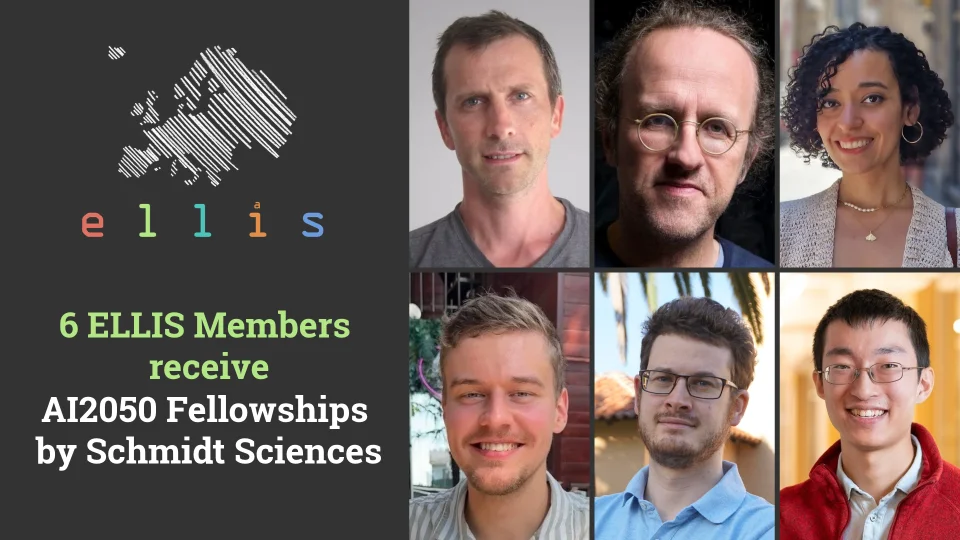
Six ELLIS Researchers Receive 2026 AI2050 Fellowships from Schmidt Sciences
The 2026 AI2050 cohort comprises 28 researchers worldwide, including six Senior Fellows and 22 Early Career Fellows. The programme provides substantial funding for ambitious research addressing key challenges that must be overcome to ensure that artificial intelligence benefits society in the long term. By supporting innovative approaches to these challenges, the fellowships help advance research into both the capabilities of AI and the safeguards needed for its responsible development.
For ELLIS, the recognition highlights the importance of fundamental research into the reliability, safety and scientific potential of artificial intelligence, to ensure it benefits society.
Senior Fellows

Francis Bach, Research Director at Inria, France's National Institute for Research in Digital Science and Technology, will develop a technical auditing framework to assess the reliability of AI actions. As AI systems increasingly use tools, plan experiments and make recommendations, it becomes essential to establish when their actions are justified. His project aims to create an external auditing layer that evaluates observed behaviour and controlled tests against explicitly defined safety constraints. The system will assess when an action is supported by evidence, when further information is needed and when an AI system should defer.

Among the Senior Fellows, Bernhard Schölkopf, Scientific Director of ELLIS Institute Tübingen and the Max Planck Institute for Intelligent Systems, will pursue a project on Causal World Models: His research aims to move beyond conventional pattern recognition on static data towards AI systems that learn by observing, acting and experimenting. By combining causal representation learning with transformer-based inference, the project seeks to develop models that can simulate actions, reason about interventions and support scientific discovery.
Early Career Fellows

Among the awarded Early Career Fellows, Sahar Abdelnabi, Principal Investigator and Independent Group Leader at ELLIS Institute Tübingen and the Max Planck Institute for Intelligent Systems, will focus on safe cooperation between AI agents. Her project, Building Trustworthy Trust: Enabling Safe Cooperation in Multi-Agent AI Ecosystems via Shaping and Controlling Inter-Agent Trust, addresses the risks of excessive trust in systems where AI agents collaborate on complex tasks. She aims to develop layered defence frameworks combining architectural safeguards, learned reasoning and policy controls to help ensure that multi-agent ecosystems remain secure, privacy-preserving and resistant to adversarial manipulation.

Maksym Andriushchenko, Principal Investigator and Independent Group Leader at ELLIS Institute Tübingen and the Max Planck Institute for Intelligent Systems, will investigate how to measure the capabilities and risks of recursive AI self-improvement. As AI systems become increasingly capable of writing code and improving other models with limited oversight, robust evaluation methods are essential. His project will develop empirical benchmarks, including PostTrainBench, to assess self-improving agents, evaluate their adherence to safety requirements and identify shortcuts or undesirable behaviours during iterative training.

Alexander Tong, Principal Investigator at Aithyra, will address limitations in AI-driven molecular design. Although generative AI has made substantial progress in producing images and text, designing molecules that behave as intended in physical and biological environments remains challenging. His project incorporates physical dynamics into generative models, using flow matching and optimal transport to estimate how molecular structures change over time. The aim is to make computational molecular design more predictable and support the development of targeted therapeutics and sustainable enzymes.

Florian Tramèr, Assistant Professor at ETH Zurich, will investigate the potential misuse of AI for cyberattacks, surveillance and privacy violations. His project aims to establish comprehensive public benchmarks to measure these capabilities and track how they develop as AI systems improve. The research will examine AI's ability to link anonymous online identities, conduct surveillance autonomously and compromise cryptographic systems. The findings are intended to inform AI safety policies, defensive tools and responsible deployment decisions.
Advancing responsible and beneficial AI
The projects represented in the 2026 AI2050 Fellowships address complementary challenges at the forefront of artificial intelligence research. They range from evaluating the reliability of individual AI actions and understanding causal relationships to securing collaboration between autonomous agents, measuring the risks of self-improving systems and advancing molecular discovery.
Together, these efforts reflect the importance of developing AI systems whose capabilities can be understood, evaluated and guided towards beneficial outcomes. The recognition of ELLIS scientists through the 2026 AI2050 Fellowships underscores the value of fundamental research made in Europe addressing the scientific and technical challenges that will shape the future of artificial intelligence.
About Schmidt Sciences and AI2050
Schmidt Sciences is a nonprofit organisation founded in 2024 by Eric and Wendy Schmidt to advance science and technology, deepen understanding of the natural world and develop solutions to global challenges. Its research support spans several areas, including artificial intelligence and advanced computing, astrophysics and space, biosciences, and climate science. The organisation supports researchers pursuing ambitious, interdisciplinary and potentially high-risk research that may be difficult to fund through conventional channels.
The 2026 AI2050 Fellowships are part of the organisation's AI2050 initiative, launched in 2022 and conceived and co-chaired by Eric Schmidt and James Manyika, Senior Vice President at Google. The initiative supports researchers addressing fundamental scientific and societal challenges in AI, with the long-term goal of ensuring that artificial intelligence benefits society. In addition to funding, fellows can participate in an international research community and exchange ideas across disciplines.
Sources:
Schmidt Sciences, 2026 AI2050 Fellows announcement, together with their project descriptions: https://www.schmidtsciences.org/ai2050-fellows-2026-announcement/