Five years of ELLIS Stuttgart: Shaping the next generation of intelligent systems
For the past five years, the University of Stuttgart has been part of the “European Laboratory for Learning and Intelligent Systems” (ELLIS) network. ELLIS connects leading European research institutions in the fields of machine learning and intelligent systems. The goal is to advance Europe's research and technological independence in these fields.
Andreas Bulling, professor of computer science at the Institute for Visualization and Interactive Systems (VIS), and Ingo Steinwart, professor of mathematics at the Institute for Stochastics and Applications (ISA), founded one of what has since become 47 Sites in the ELLIS network in 2021.

Together with other Fellows at the University of Stuttgart and at the Max Planck Institute for Intelligent Systems (MPI-IS), they are conducting research on the scientific foundations of modern intelligent systems.
In this interview, Bulling and Steinwart look back on the past five years and discuss how they plan to further develop the Stuttgart-based ELLIS Unit in the future.
Prof. Bulling und Prof. Steinwart, you founded the ELLIS Unit in Stuttgart five years ago. How has ELLIS enriched research at the University of Stuttgart since then?
Bulling: ELLIS is recognized as a top-tier network in machine learning and AI research –both in Europe and internationally. The establishment of an ELLIS Unit is preceded by an intensive selection process. Inclusion in the network is an honor and demonstrates that the University of Stuttgart is among the leading institutions in these fields of research in Europe. This ensures high visibility within the research community. That was another reason why we wanted to establish an ELLIS Unit in Stuttgart.
Steinwart: Our Unit also makes the University of Stuttgart an attractive option for early-career researchers. Many people specifically choose an ELLIS location for their doctoral studies or postdoctoral fellowship. Every year, several thousand candidates from around the world apply to the ELLIS PhD program. Many people specifically look at the locations and want to do their doctoral studies there for that very reason.
In which research areas can early-career researchers get involved at the ELLIS Unit in Stuttgart?
Steinwart: Our Fellows come from a wide variety of disciplines – ranging from mathematics and computer science to cognitive science, AI, and robotics. We work closely together in an interdisciplinary manner and examine scientific questions from different perspectives.
Bulling: In line with the University of Stuttgart’s vision of “Intelligent Systems for a Sustainable Society,” this work always addresses issues that are relevant to the future of our society. A key mission of our Unit is to improve collaboration between humans and intelligent systems.
What exactly are you researching in this area?
Steinwart: Our basic research aims to understand the fundamental mechanisms of learning and interactive, intelligent systems. These findings are intended to advance AI and machine learning methods and algorithms and improve human-machine collaboration.
Bulling: To illustrate this with an example: When people interact with one another, they assess the other person by constantly evaluating their tone of voice, gaze, body language, and facial expressions. And all without having to think too much about it or make much of an effort. These cognitive abilities are crucial to our ability as humans to collaborate so efficiently, which is why we want to “teach” them to technical systems as well. This could enable AI assistants or service robots, for example, to learn to recognize user intentions early on and act proactively.
How do you plan to achieve that?
Bulling: The interdisciplinary collaboration within our Unit is a key advantage in this regard. First, we focus on cognitive modeling. We are developing the foundations for algorithms that enable an intelligent system to recognize the intentions of another party and respond to them. On the other hand, we are exploring how technical systems can better perceive their environment visually and utilize knowledge. Or how learning and action capabilities can be transferred to robotic systems. Through close interdisciplinary collaboration, we are able to develop solutions to these challenges and integrate them into a single system.
What has been your personal highlight after five years at ELLIS Stuttgart?
Steinwart: We are particularly proud of our “Distinguished Lecture Series.” To date, we have invited more than 40 leading researchers from all over Europe to this lecture series in Stuttgart. The presentations thrive on open dialogue and have made our Unit well-known throughout Europe. That is exactly what defines the spirit of ELLIS: bringing together people from different disciplines and locations.
What does the future hold for ELLIS in Stuttgart?
Bulling: We definitely want to remain the ELLIS Unit! We are currently applying for a five-year extension. Of course, we want to expand our research and integrate the disciplines even more closely. We would also like to expand collaboration within the network – here in Stuttgart, but also with other ELLIS locations. To that end, we are planning a summer or winter school. We also plan to continue the Distinguished Lecture Series and expand it to include tutorials specifically for students and early-career researchers. At the same time, we would like to make all of these formats available to companies in the region as well. Our goal, then, is to further develop the ELLIS Unit in Stuttgart as a place where different perspectives on AI come together and new ideas emerge.
Further information
The interview was provided by the ELLIS Unit Stuttgart and was originally published here.
Find out more about the ELLIS Unit Stuttgart and its members here.
Check out this page to learn more about other ELLIS Sites across Germany and Europe.
Image credits:
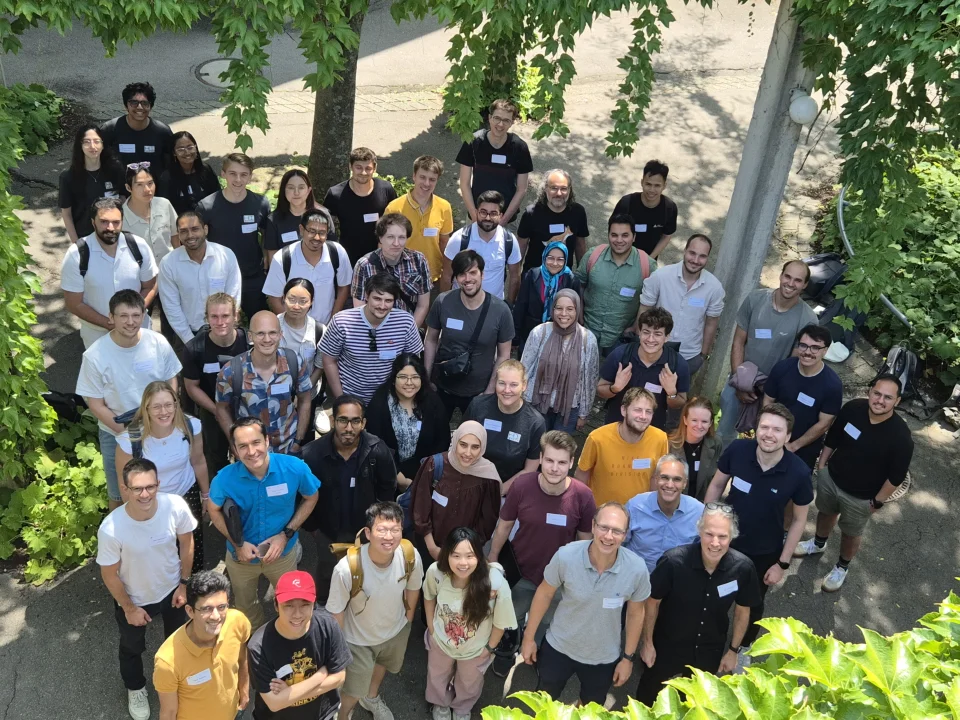
ELLIS Unit Stuttgart group photo: Copyright 'ELLIS Unit Stuttgart'
Portrait photos Andreas Bulling & Ingo Steinwart: Copyright 'University of Stuttgart / ELLIS'