
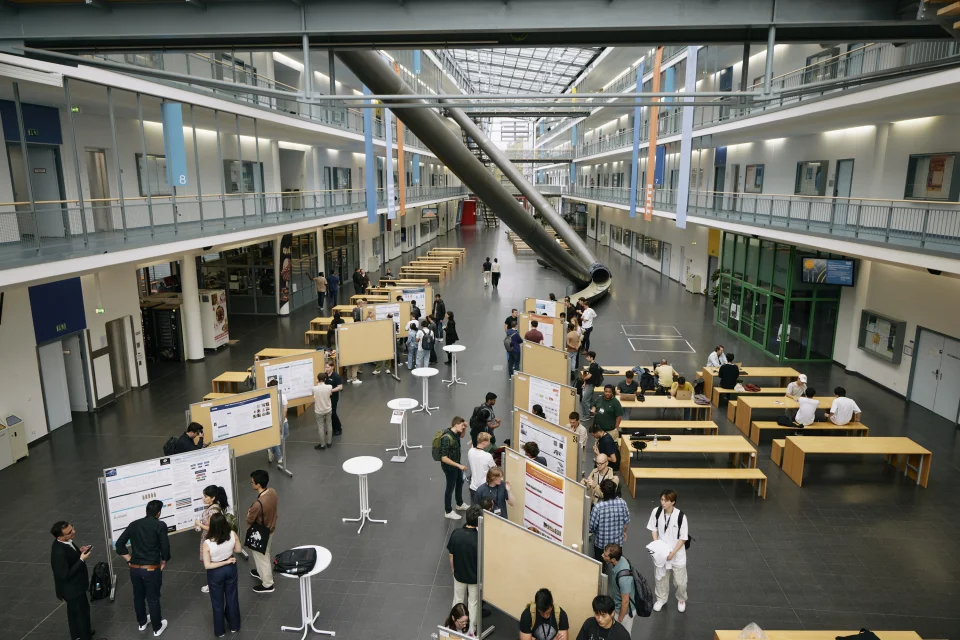
ELLIS Unit Munich: Summer School on Computer Vision and Machine Learning 2026
Participants and Programme
Around 600 applications came in, and gender balance and geographic diversity were weighed alongside academic merit in the selection. 111 researchers were present in Garching, almost half of them doctoral researchers, followed by master's students, senior researchers and industry professionals.
Daniel Cremers, Director of ELLIS Unit Munich, opened the school on 15 September. Twelve lecturers taught across the four days.
Speakers came from Munich and abroad, and the programme deliberately spanned machine learning, computer vision and natural language processing. Daniel Cremers on why: "We think it is important to give you a picture beyond your own research. Research profits from the transfer of expertise and know-how from one domain into another. Next-token prediction and large language models surfaced in NLP and were carried over to computer vision. There is a lot of interaction across these communities, and it is important to have everyone on board."
Eleven doctoral researchers presented in the lightning talk session on the opening afternoon, from causal concept explanation to diffusion model interpretability and fMRI-based disease prediction.
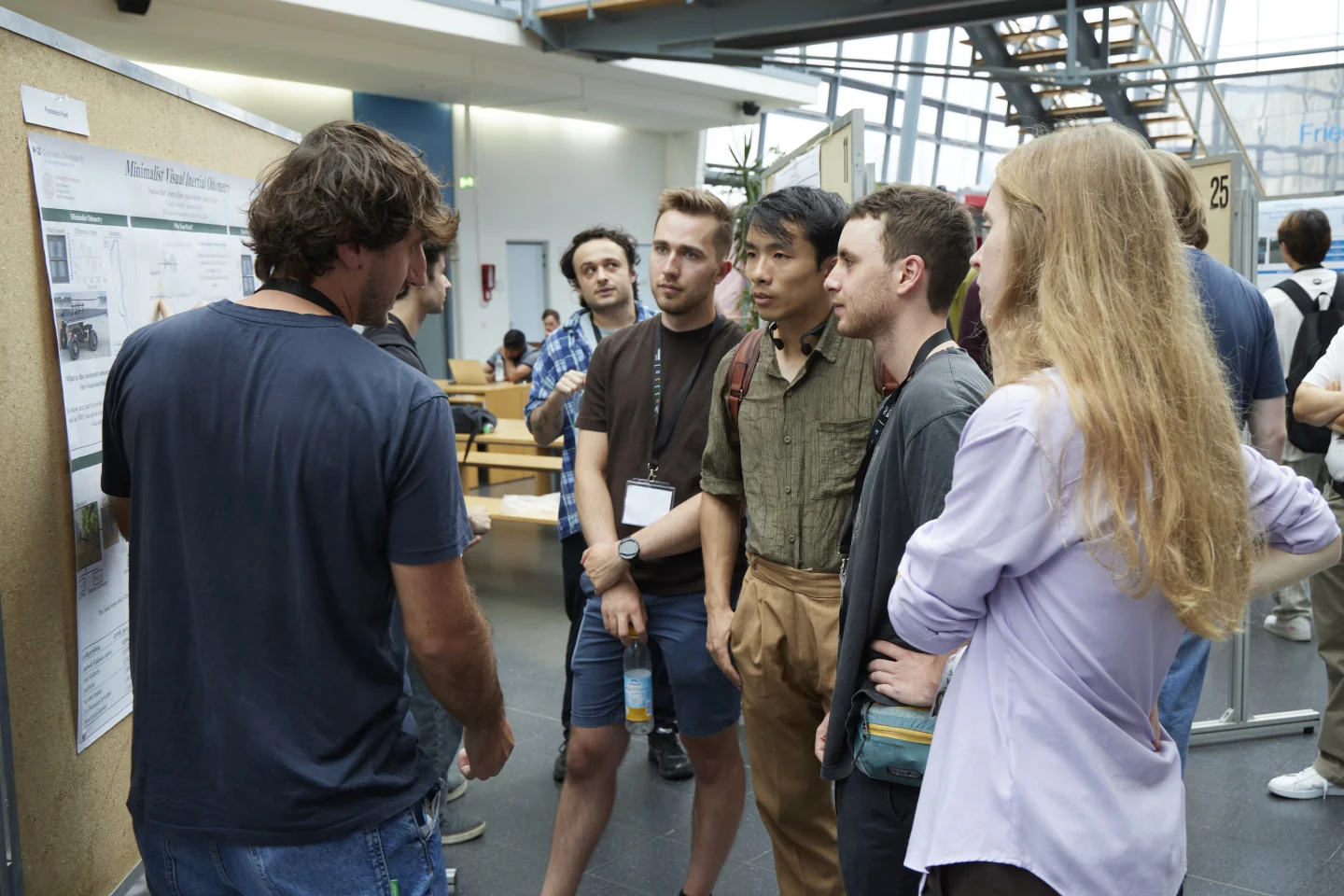
The two poster sessions, on 16 and 17 September, carried 43 posters between them, on subjects from slot attention and image registration to medical vision-language models, driving scene reconstruction and atmospheric modelling.
The school closed on 18 September at the Auditorium of the Institute for Advanced Study at TUM Campus Garching with closing remarks and poster awards.
Key Takeaways from the Talks
A question running through the week was what current models cannot do without the right memory, inductive bias or guarantees, and what follows for how they are built.
Kilian Weinberger (Cornell University) opened the lecture programme by arguing that progress beyond today's language models requires a shift from parametric to external memory, and from token-by-token generation to architectures that reason globally before committing to tokens. Hinrich Schütze (LMU Munich) came at memory from the other direction, with a continual-learning architecture inspired by human and animal memory and a model in which facts sit in a semantic structure rather than as rows in a database. Zeynep Akata (TU Munich / Helmholtz Munich) spoke on explainability and adaptation in multimodal LLMs.
On visual representation, Daniel Cremers (TU Munich) lectured on 3D computer vision in the age of deep learning, and Yuki Asano (University of Technology Nuremberg) made the case for moving beyond classical visual representations, drawing on his work in self-supervised and vision-language learning. Björn Ommer (LMU Munich) closed Thursday on generative AI, reflecting his work on visual synthesis including Stable Diffusion.
Shai Ben-David (University of Waterloo) set out the role of domain-specific inductive bias and task specialisation in performance guarantees, drawing examples from animal learning to algorithmic fairness, under the title "On the inevitability of inductive bias and the impossibility of hands-off AGI"; he returned on the final day on sample compression schemes. Stephan Günnemann (TU Munich) examined adversarial attacks and the wider problem of building reliable systems, Christoph Lampert (Institute of Science and Technology Austria) covered learning with data privacy, and Tinne Tuytelaars (KU Leuven) closed the school on keeping models up to date, from catastrophic forgetting to foundation models, instruction tuning and agentic AI.
Two lectures addressed the work around the research. Aykut Erdem (Koç University) spoke on developing multimodal benchmarks, drawing on RecipeQA, CRAFT, ViLMA, ComPACT and PhysVidBench, and on how benchmark design shapes what the field optimises for. Verena Albrecht (MCML / LMU Munich) introduced a framework for communicating AI research to journalists, policymakers and interdisciplinary audiences, including how to convey uncertainty and ongoing scientific disagreement.
A further session came from the MINERVA European Support Centre: "HPC in Europe", by Michael Tiemann (University of Tübingen), mapped the routes to research computing from university clusters up to the EuroHPC JU systems, with the costs, waiting times and application effort at each level, on the argument that limited compute should not hold back research.
Impressions from the Summer School
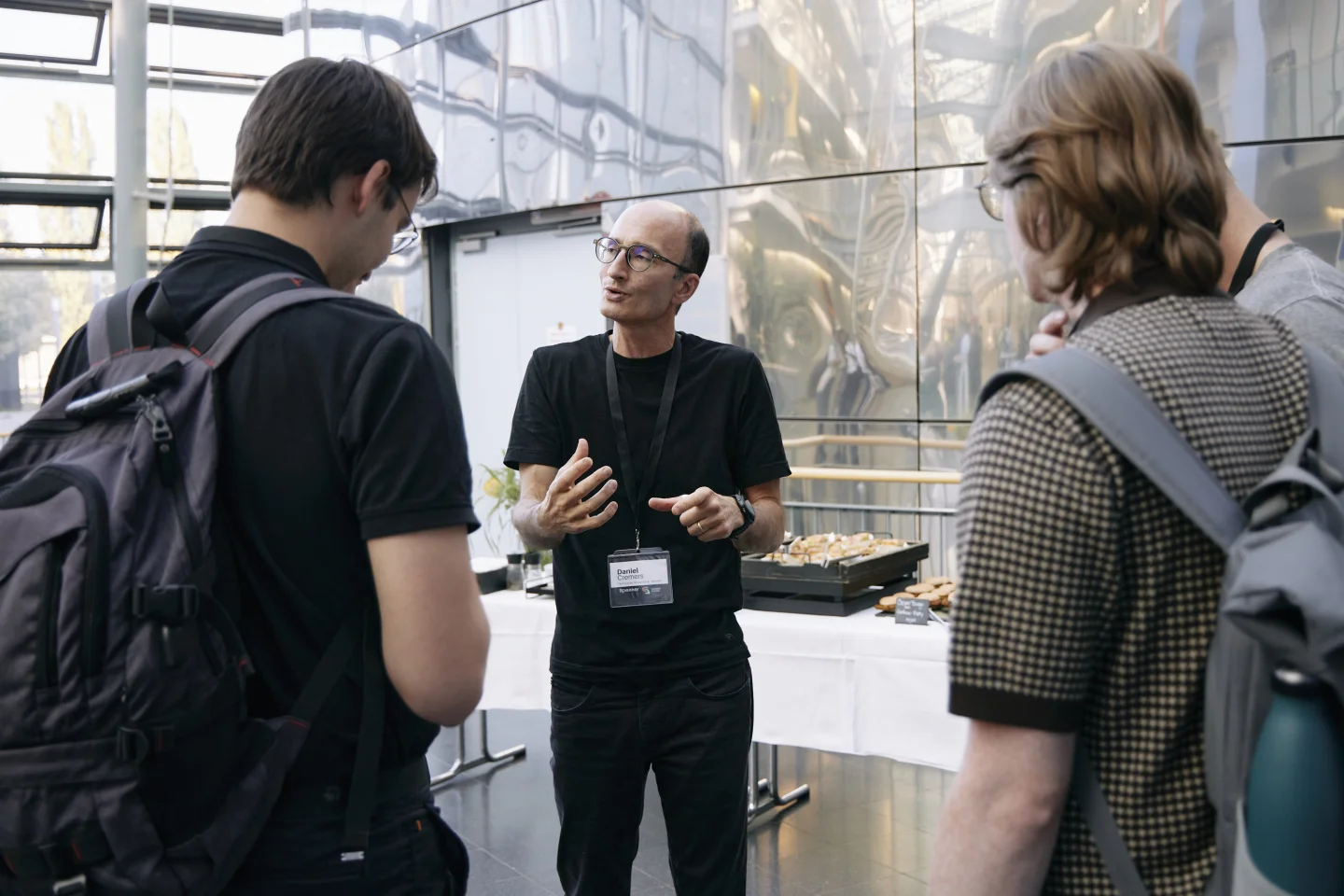
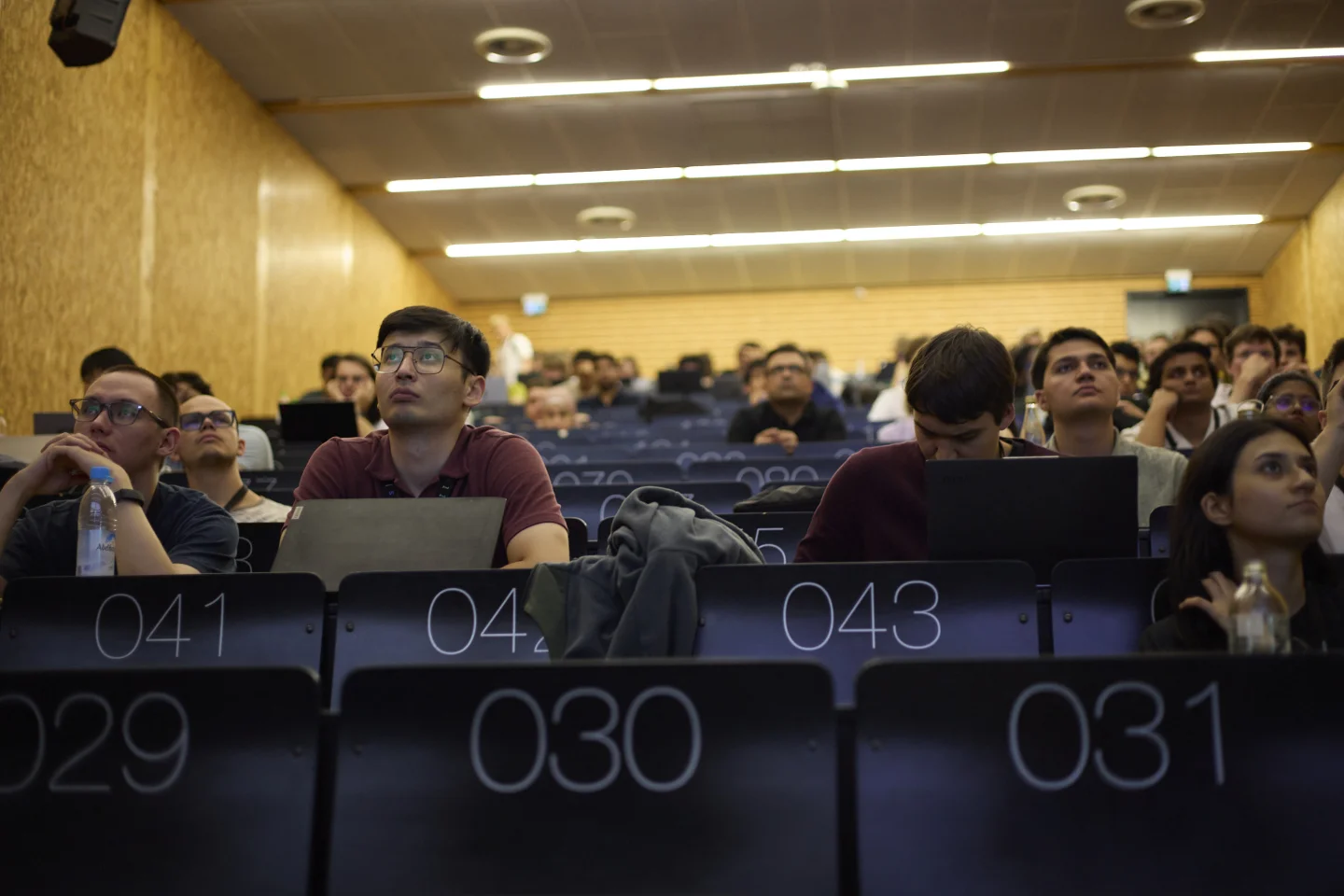
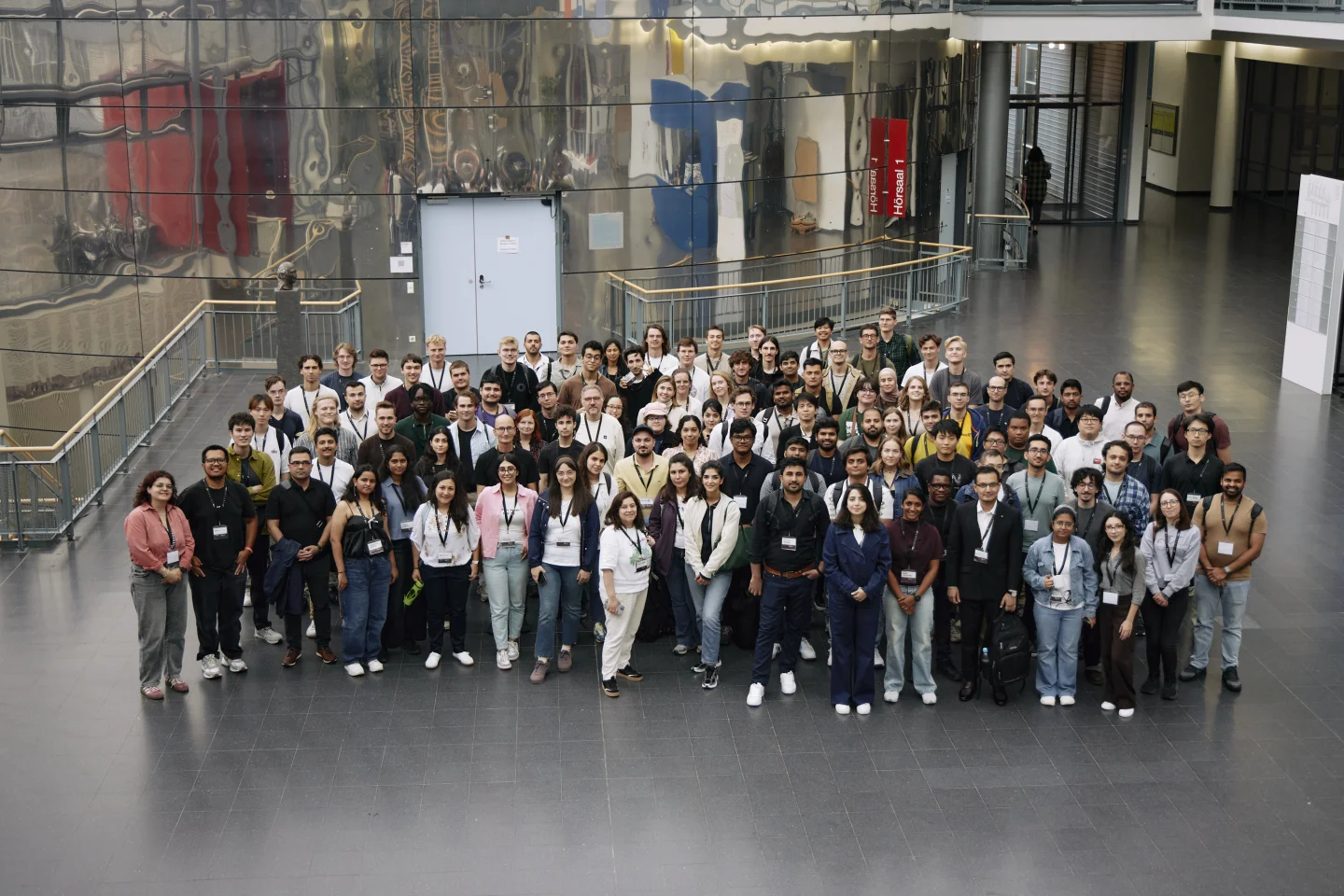
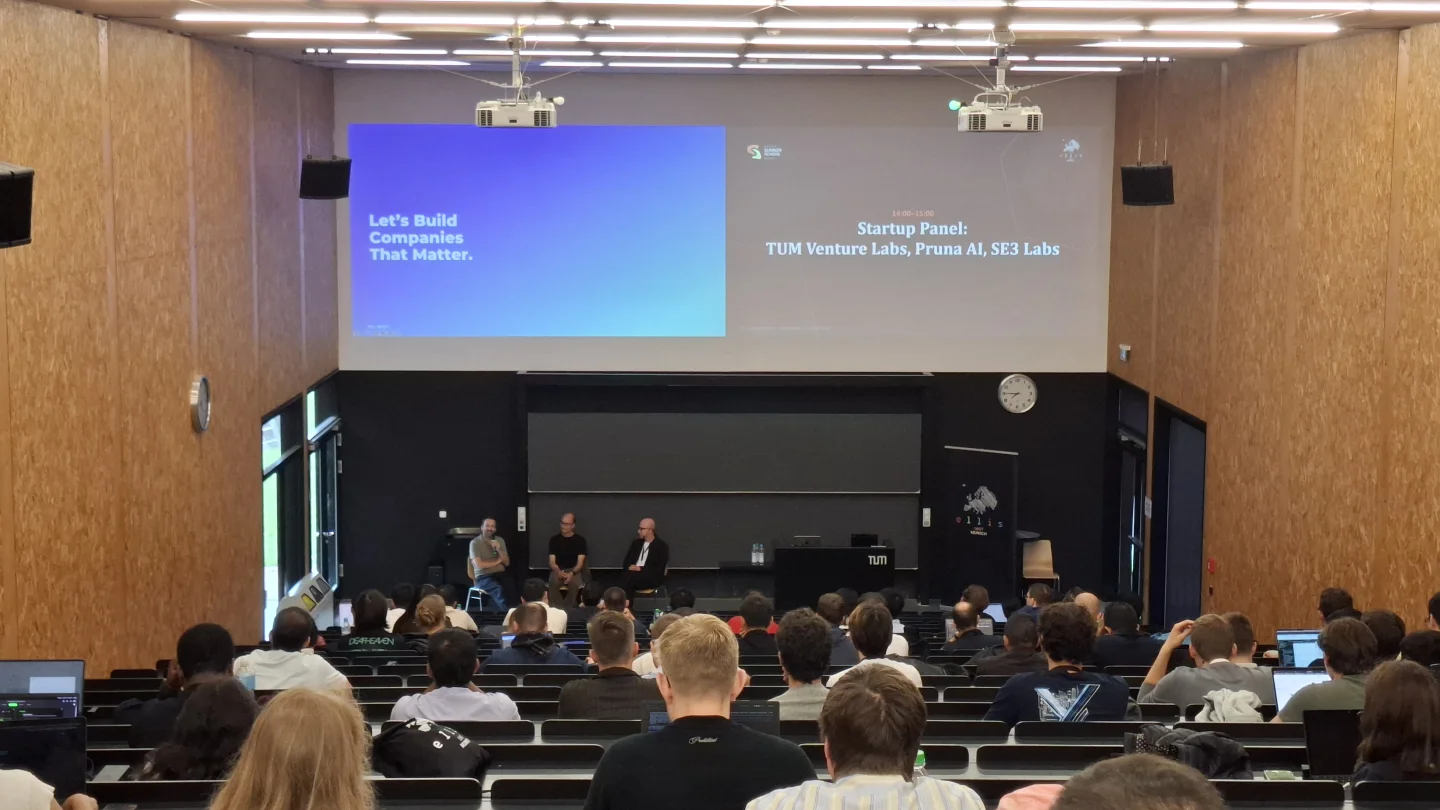
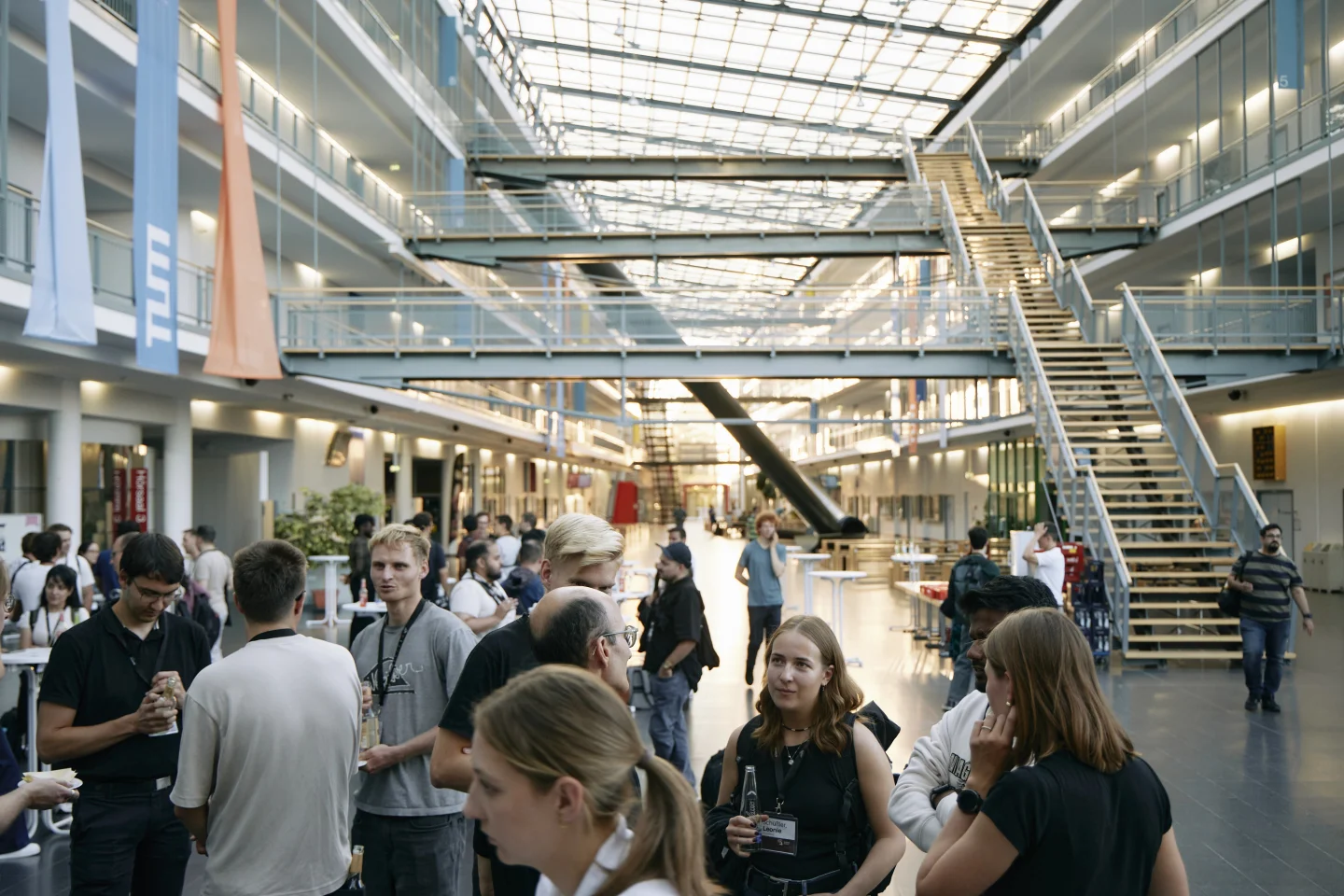
Credit for the startup panel image: Toghrul Hajizada
Credit for all other images: Oliver Spies
The Startup Panel
On the afternoon of 17 September, an hour of the programme went to what happens when machine learning and computer vision research leaves the university. Daniel Cremers moderated and spoke for SE3 Labs, Stephan Günnemann joined for Pruna AI two days after his lecture on adversarial attacks, and Marc Bürkle represented TUM Venture Labs — founders and investors working in the same areas as the week's lectures.
Cremers put the panel on the programme on the argument that researchers increasingly want the technology they develop to reach the world and have an impact on society, which often happens through a startup. The panellists gave practical lessons from building deep tech companies: listen closely to potential customers, choose co-founders carefully, since the team largely determines how well an idea is executed, and look after your mental health. As a company grows, they added, regular team activities keep people connected.
"There are a lot of domains where the future is not defined, but you, with your skills, can build the future."
— Marc Bürkle, TUM Venture Labs
Insights from Participants
The programme gave participants both input for current work and the start of new collaborations. Mohamedou Cheikh Tourad, Associate Professor at the Université de Nouakchott:
"For me, the ELLIS Summer School in Munich was the scientific highlight of the year. I still think about Daniel Cremers' lecture on 3D vision, and about what Kilian Weinberger, Hinrich Schütze, and Zeynep Akata said on memory and explainability in LLMs — questions I face every day in my work on African low-resource languages. I go home with new methods to test, and hopefully the start of a collaboration between TUM and the Université de Nouakchott."
Leonie Schüßler and Sebastian Bock (TU Darmstadt), whose poster MUFASA: A Multi-Layer Framework for Slot Attention won an award in the first session:
"The ELLIS Summer School in Munich was a great and inspiring week. The speakers provided a deep dive into current research and offered new perspectives to take home and think about. What made the week especially memorable was connecting with other participants from all around Europe. A big thank you to the organizers for bringing us all together, making this experience possible, and awarding our poster!"
Robin Nurcin, a PhD student at the University of Geneva, found the same value in the mix of disciplines that Cremers had set out on the first morning:
"What stayed with me was seeing how differently researchers from other disciplines approach the same problems. Where I tend to ask how people perceive, trust, and interact with AI systems, many of the discussions started from what a model actually learns and represents. Holding both views side by side gave me plenty of new ideas to take back to my own work."
Organisers and Partners
ESC26 was organised by the Technical University of Munich as part of ELLIS Unit Munich, within the ELLIS Society network. The organising committee was Daniel Cremers, Zeynep Akata, Björn Ommer, Nikita Araslanov and Stefan Roth; coordination was led by Ellia Wamese with Toghrul Hajizada, Paulina Figueroa, Emma van Holthe and Sandra Schulze.
The organisers gratefully acknowledge the support of:
Technical University of Munich, host institution
Konrad Zuse School of Excellence in Learning and Intelligent Systems (ELIZA), which funded the school. ELIZA is coordinated by TU Darmstadt and funded by the German Academic Exchange Service (DAAD).
Helmholtz Munich and LMU Munich, supporting institutions
Munich Center for Machine Learning (MCML), organisational support. MCML is a joint initiative of TUM and LMU Munich, institutionally funded by the German Federal Ministry of Research, Technology and Space (BMFTR).
The organisers also thank the twelve lecturers, the startup panellists and all participants for the engagement during the school.
The article was provided by Ellia Wamese, Coordinator of the ELLIS Unit Munich.
Website of the ELLIS Unit Munich: https://www.ellismunich.ai/
Credit for the header image: Oliver Spies