ELLIS Unit Delft: Machine Learning at the Intersection of Engineering and Real-World Challenges
Key Numbers & Achievements
The ELLIS Unit Delft joined the European Laboratory for Learning & Intelligent Systems in 2019 as one of the network's 17 founding units, and has grown into the fourth-largest unit in the network. The motivation was clear: TU Delft's strength as a world-leading engineering school made it well positioned to bridge fundamental "in-AI" research and domain-specific "with-AI" applications, and ELLIS offered a means to connect with Europe's top machine learning talent, collaboration opportunities, and a network-wide certification of research excellence.
That motivation has borne out in concrete outcomes on campus, with the Unit now co-directing 11 of the 24 Delft AI Labs. Today the Unit brings together 40+ researchers spanning four faculties (including 7 fellows and 5 scholars), reflecting the deliberately cross-disciplinary character of machine learning for the real world.

At TU Delft, AI is increasingly part of our labs and our education. As a technical university strong in engineering, robotics, and design, we see firsthand how AI and ML are reshaping these fields, creating new challenges and exciting opportunities to innovate responsibly – something that we believe is best done collaboratively. It was clear that being part of this network of Europe’s top researchers and institutions in AI is extremely important for us – to allow our community to connect and exchange, as well as to bring engineering challenges to the ELLIS community.
Research Areas & Highlights
Machine Learning is a key research theme at TU Delft and the ELLIS Delft Unit has played an important role in connecting the involved researchers and coordinating this theme. ELLIS Unit Delft is embedded within TU Delft’s research, education, and innovation ecosystem, with members contributing to various local and regional activities. This includes participating in the TU Delft | AI Initiative, acts as a platform to connect AI activities across the university, as well as Mondai | House of AI, a regional hub focused on public and private sector partnerships. Further, members have leadership roles in the TU Delft Robotics Institute, the TU Delft Safety & Security Institute, the Centre for Meaningful Human Control, and the Delft Design for Values Institute.
Among ELLIS Unit Delft's most notable contributions is the nuScenes dataset, led by Holger Caesar, cited over 7,000 times and widely used as an industry-standard benchmark for autonomous-vehicle perception research. You can access the dataset here: https://www.semanticscholar.org/paper/nuScenes:-A-Multimodal-Dataset-for-Autonomous-Caesar-Bankiti/9e475a514f54665478aac6038c262e5a6bac5e64
The Unit's work has also earned formal recognition, with M. Suau, M.T.J. Spaan, and F.A. Oliehoek receiving the Outstanding Paper Award on Scientific Understanding in RL at the first Reinforcement Learning Conference: https://www.tudelft.nl/2024/delft-ai/ellis-unit-delft/outstanding-paper-award-on-scientific-understanding-in-rl
Ongoing Research Projects
Research activities within the unit encompass a wide range of techniques and applications within machine learning, which can be broadly categorised into six themes:
Bayesian, probabilistic, statistical & causal machine learning: Using Bayesian reasoning within machine learning allows us to reason in terms of statistics, probabilities, uncertainties, and causality. This theme brings together researchers from theoretical disciplines, focusing e.g. on computational efficiency, decision-making, causal inference and supervised learning, as well as researchers from the application fields of e.g. perception for intelligent vehicles, visual data for architectural design, computational molecular biomedicine, socially aware surveillance systems, and sensor fusion.
Sequential decision making: Often AI must make more than one decision, and in sequential tasks past decisions can affect future possibilities. This temporal delay of cause and effect requires us to rethink modern AI approaches, and requires new methods for specification, learning, solving, deployment and verification. The ELLIS Delft unit brings together researchers from theoretical disciplines, like planning, reinforcement learning and verification, with applied researchers in robotics, trustworthy AI, decision support and autonomous driving.
Verification & safe and Responsible AI: Machine learning (ML) has achieved superhuman performance in numerous applications. However, most existing ML techniques are domain specific and their results are often not interpretable. For domains where correctness is critical, ensuring that ML provides worst-case guarantees is an open problem. Formal methods, such as verification and monitoring, are rich in languages and algorithms to specify and ensure correctness, yet their application to systems with ML components has been explored only in a few specific problems. Verified and Responsible AI (VRAI) unites research efforts in making machine learning and formal methods speak a common language and providing guarantees for ML-enabled systems during their design and deployment
Multiagent Systems & Robust and Adversarial ML: Multi-agent systems (MAS) and multi-agent learning (MAL) have gained significant attention due to their potential in addressing complex problems that cannot be solved by a single agent. These systems are composed of multiple autonomous agents that interact with their environment and each other to achieve their objectives. However, ensuring coordination and cooperation among multiple agents in complex environments remains a challenge with applications in robotics, energy networks, cybersecurity, and transportation, among others. Additionally, balancing exploration and exploitation, dealing with non-stationarity and partial observability, and lack of interpretability in some models are challenges that require new approaches, including game theory, deep reinforcement learning, communication protocols, and insights from psychology and social sciences
Deep Learning & Representation Learning: In recent years, significant breakthroughs in deep learning have hailed a new era in machine learning with unprecedented performance improvements. This has led to many initiatives to integrate previously understood domain knowledge (e.g. computer vision, speech processing, multimodal fusion, graph theory etc.) into deep learning systems. Aside from focusing on settings where large labelled datasets are available, this theme also tackles machine learning problems when labelled data are not available. Many important problems exist that do not have resources to collect vast datasets and therefore to train end-to-end models. Fortunately representation learning studies how patterns in unlabelled data can also be exploited. This brings about huge benefits for transferring knowledge between problems. In this theme, many different sources of data are considered from traditional audio-visual modalities, dna sequences, or event cameras. We investigate all different forms of network including properties of spiking neural networks. Finally, the growth of this field has also led to challenges in verifying the quality of research works put in the public domain.
Optimization & Computational techniques: We study how optimisation has a role in machine learning, and how machine learning has a role in optimisation. Specific topics are inverse optimisation, use of ML in search techniques such as branch-and-bound, and stochastic systems; together with computational aspects for efficient ML, such as low-rank approximation.
In addition to participating in several national and European funded projects, ICAI Labs, and field labs, ELLIS Unit Delft's launched the Programme Starter Fund in 2025 as a vehicle to support early-stage collaborations. Three initiatives are currently supported:
Metascience for Machine Learning (Hayley Hung, Jan van Gemert, Marco Loog), addressing reproducibility in ML research; the Generative AI Working Group (Hadi Jamali-Rad, Xucong Zhang), coordinating generative AI efforts across faculties and industry;
The LLM-Benchmark for Thesis Writing pilot project (Tom Viering), building a benchmark dataset for automated academic feedback;
The Unit is also an Associate Partner of the EU-funded ELSA project (lead Anna Lukina) and member of the ELIAS Virtual Centre (lead Mathijs de Weerdt).
Collaborating across ELLIS
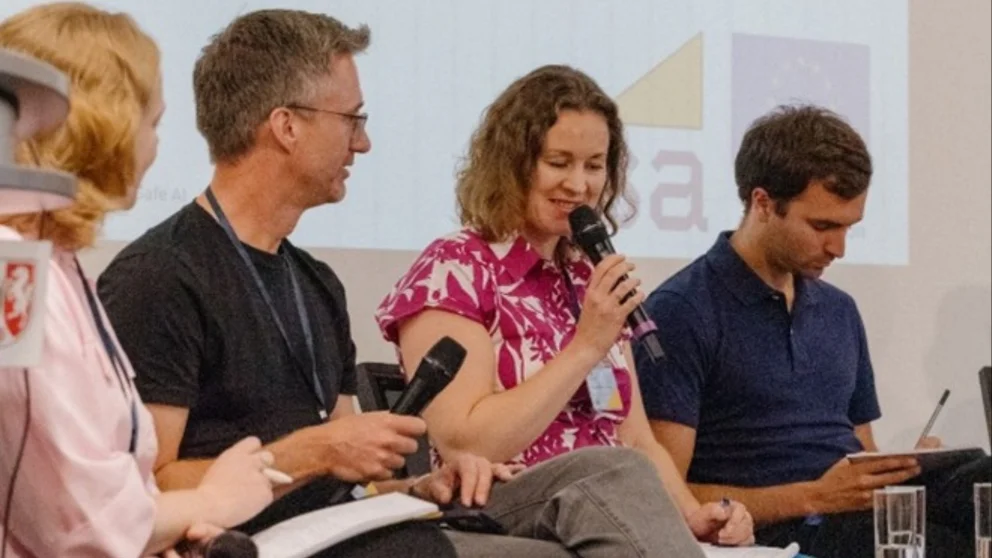
The ELLIS Unit Delft actively collaborates with fellow ELLIS Units across Europe. In 2026, Holger Caesar, Co-Director of the Unit, presented at the ELLIS Madrid Unit, strengthening research ties and knowledge exchange between the two sites. Closer to home, the Unit has deepened its cooperation with the other Dutch ELLIS Units (Nijmegen and Amsterdam) with activities such as co-hosting the 2nd ELLIS Coordinators Retreat in October 2025, bringing together coordinators from across the ELLIS network to discuss operations, communications, and inter-unit collaboration.
Our members also regularly work together on publications with members from other ELLIS units, for example:
Symformer: End-to-end symbolic regression using transformer-based architecture
Martin Vastl, Jonáš Kulhánek, Jiří Kubalík, Erik Derner (Unit Prague), Robert Babuška (Unit Delft)ViewFormer: NeRF-free Neural Rendering from Few Images Using Transformers
Jonáš Kulhánek, Erik Derner (Unit Prague), Torsten Sattler (Unit Prague), Robert Babuška (Unit Delft)Opendr: An open toolkit for enabling high performance, low footprint deep learning for robotics
Nikolaos Passalis, Stefania Pedrazzi, Robert Babuška (Unit Delft), Wolfram Burgard, Daniel Dias, Francesco Ferro, Moncef Gabbouj, Ole Green, Alexandros Iosifidis, Erdal Kayacan, Jens Kober (Unit Delft), Olivier Michel, Nikos Nikolaidis, Paraskevi Nousi, Roel Pieters, Maria Tzelepi, Abhinav Valada (Unit Freiburg), Anastasios TefasOverlapping Schwarz preconditioners for randomized neural networks with domain decomposition
Yong Shang, Alexander Heinlein (Unit Delft), Siddhartha Mishra (Unit Zurich), Fei WangTracking Network Dynamics using Probabilistic State-Space Models
Victor M. Tenorio; Elvin Isufi (Unit Delft); Geert Leus; Antonio G. Marques (Unit Madrid)
Support for Young Talents
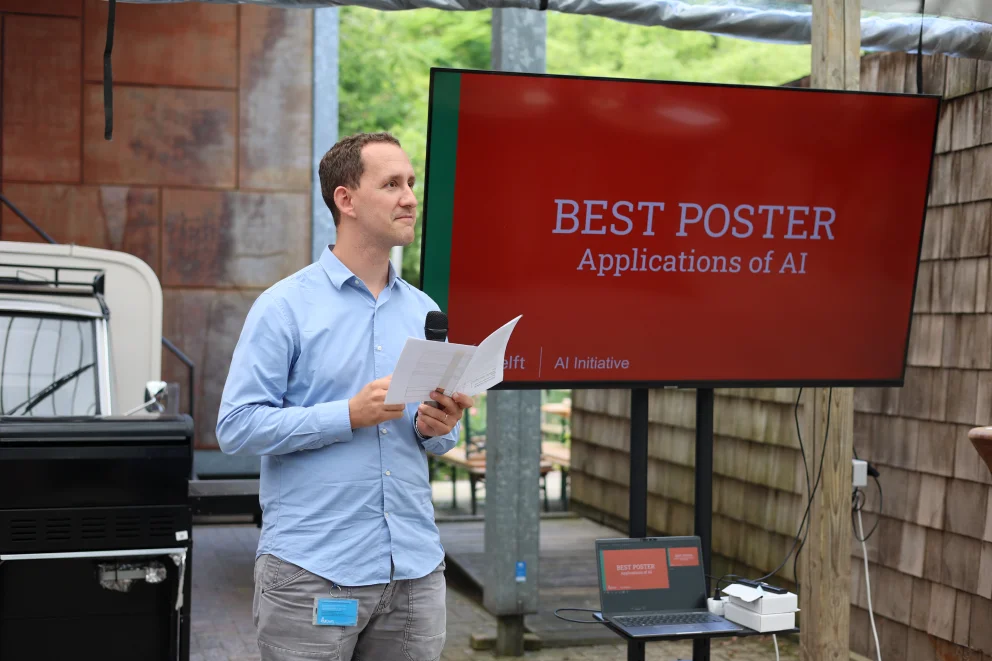
The ELLIS Unit Delft supports early-career researchers in a few distinct ways. It supports the annual MSc AI thesis prize and AI PhD community events on campus and nationally - providing recognition, networking opportunities, and a platform to showcase research.
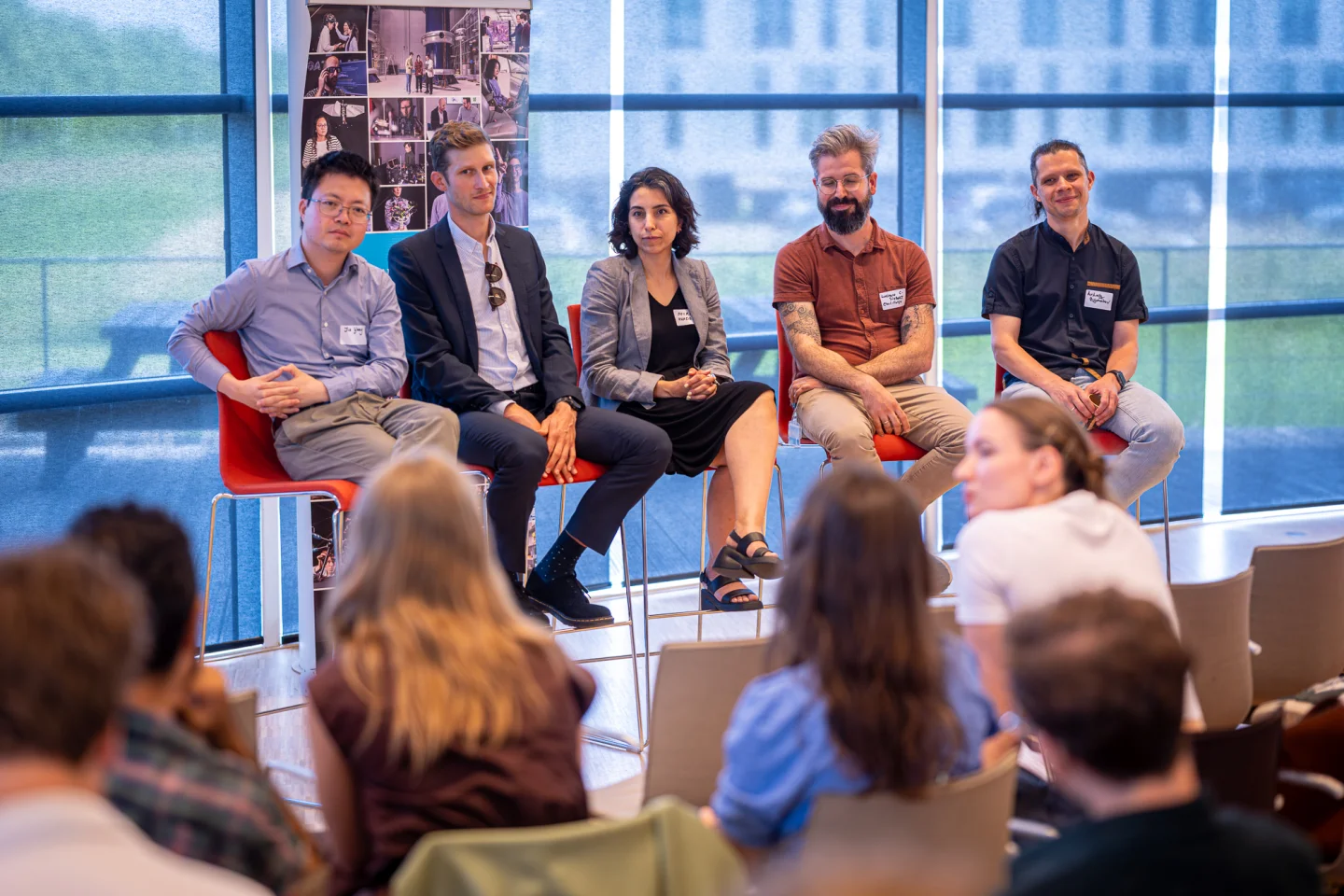
It also hosts a regularly occurring Machine Learning Insights Seminar Series, for which PhDs can gain credits, offering a regular space for learning and knowledge exchange. In our most recent seminar, we collaborated with an industry partner for the first time, Adyen, bringing together a diverse audience of students, researchers, and industry professionals, and fostering exchange between young talent in academia and industry.
Efforts in Public Engagement
Towards our mission to foster and advance machine learning for the real world, the unit actively fosters a collaborative approach through community building and knowledge exchange activities on campus, with regional partners, and within the ELLIS network. Through these efforts, the ELLIS Unit Delft works to align state-of-the-art developments in machine learning science with domain-specific applications in science, engineering, and design.
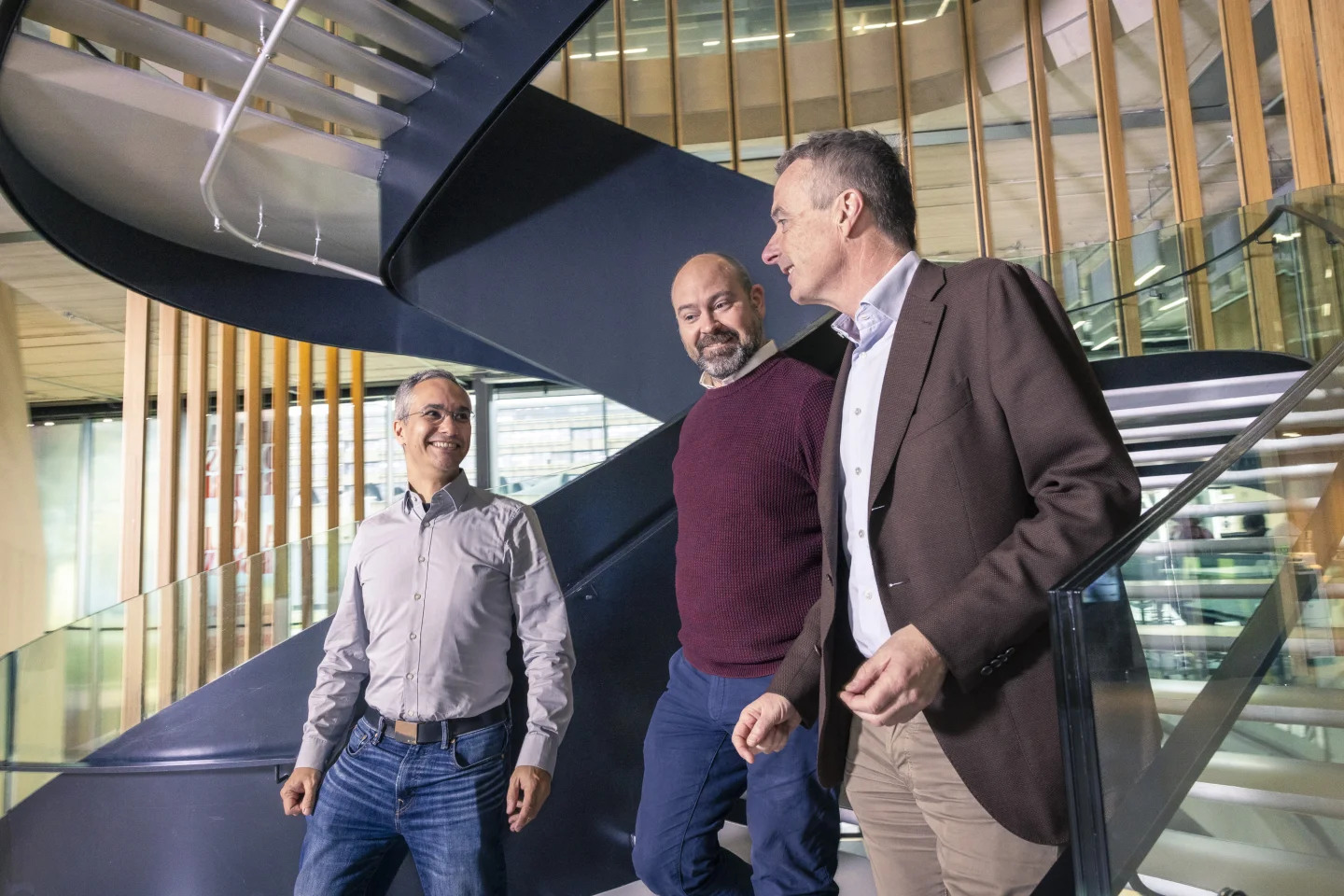
ELLIS Unit Delft members lead initiatives such as the Special Interest Group on Translating the EU AI Act into Technical Requirements, and through its Associate Membership in ELSA (European Lighthouse on Secure and Safe AI), which positions the Unit at the forefront of trustworthy AI research aligned with European values. Further, members regularly discuss their work, and the larger field and direction of machine learning, in public-facing venues, such as an interview of the Unit’s co-director’s by TU Delft’s Pro Vice Rector of AI, Data, and Digitalisation.
View the highlights summary:
Text written by ELLIS Unit Delft Coordinator Taylor Stone.