6th ELLIS Summer School on AutoML Puts Agentic AutoML in the Spotlight
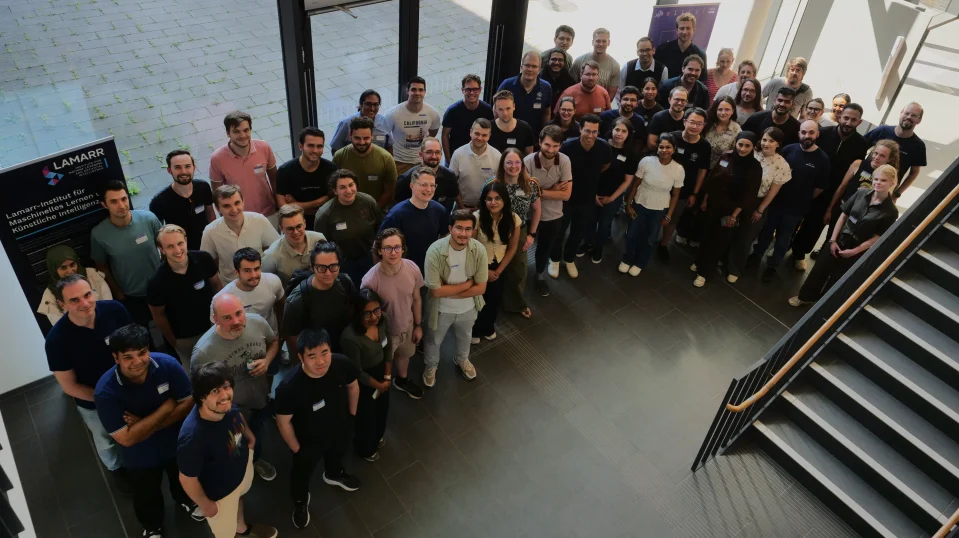
The programme included talks by AutoML researchers and practitioners from industry, as well as hands-on sessions and a poster session in which participants could present their own research. The AutoML Summer School is an annual research training event for graduate and postgraduate students, research engineers, industry practitioners, and prospective users of AutoML.
Over five days, participants explored both the foundations of AutoML and some of the field’s most recent developments. This year’s edition placed a special emphasis on agentic systems and the growing role of large language models in automating complex machine learning and data science workflows.
From AutoML Foundations to Foundation Models to Agentic AutoML systems
The scientific programme began with the foundations of Bayesian optimization. Bernd Bischl introduced its central concepts and methodology, while Katarzyna Kobalczyk presented preferential Bayesian optimization, an approach for problems in which objectives are difficult to express numerically but alternatives can still be compared or ranked.
Another central AutoML technique, neural architecture search (NAS), was introduced in a tutorial by Jovita Lukasik, followed by a hands-on session by Kıvanç Tezören. While much current research focuses on increasingly large neural networks, Andreas Kist complemented these sessions with examples of NAS for resource-constrained edge devices, where predictive quality must be balanced against practical limitations such as latency, memory consumption, and energy use.
The programme also covered several current research challenges in AutoML. Marius Lindauer discussed how hyperparameters can be adapted during model training, potentially allowing deep neural networks to be trained more efficiently. Aaron Klein presented how the OpenEuroLLM project uses scaling laws to pre-train large foundation models and how the results are shared in a completely open way. Finally, Marcel Wever introduced the audience to game-theoretic approaches for interpreting the inner workings of AutoML systems, putting an emphasis on human users of AutoML systems.
The future of AutoML is agentic.
Joaquin Vanschoren (TU Eindhoven)
Agentic systems formed the special focus of this year’s school. Elisabeth Kirsten introduced the progression from individual tool-using language models to orchestrated agent systems. Joaquin Vanschoren examined AutoML systems in practice and how they can be evaluated. Last but not least, Niki van Stein explored the direction of using large language models for discovering novel programs that follow a clear structure, e.g., black-box optimization heuristics and Bayesian optimization algorithms.
In the future it will not be about who has the best Bayesian optimization algorithm, but the best generator to design new Bayesian optimization algorithms.
Niki van Stein (Leiden Institute of Advanced Computer Science)
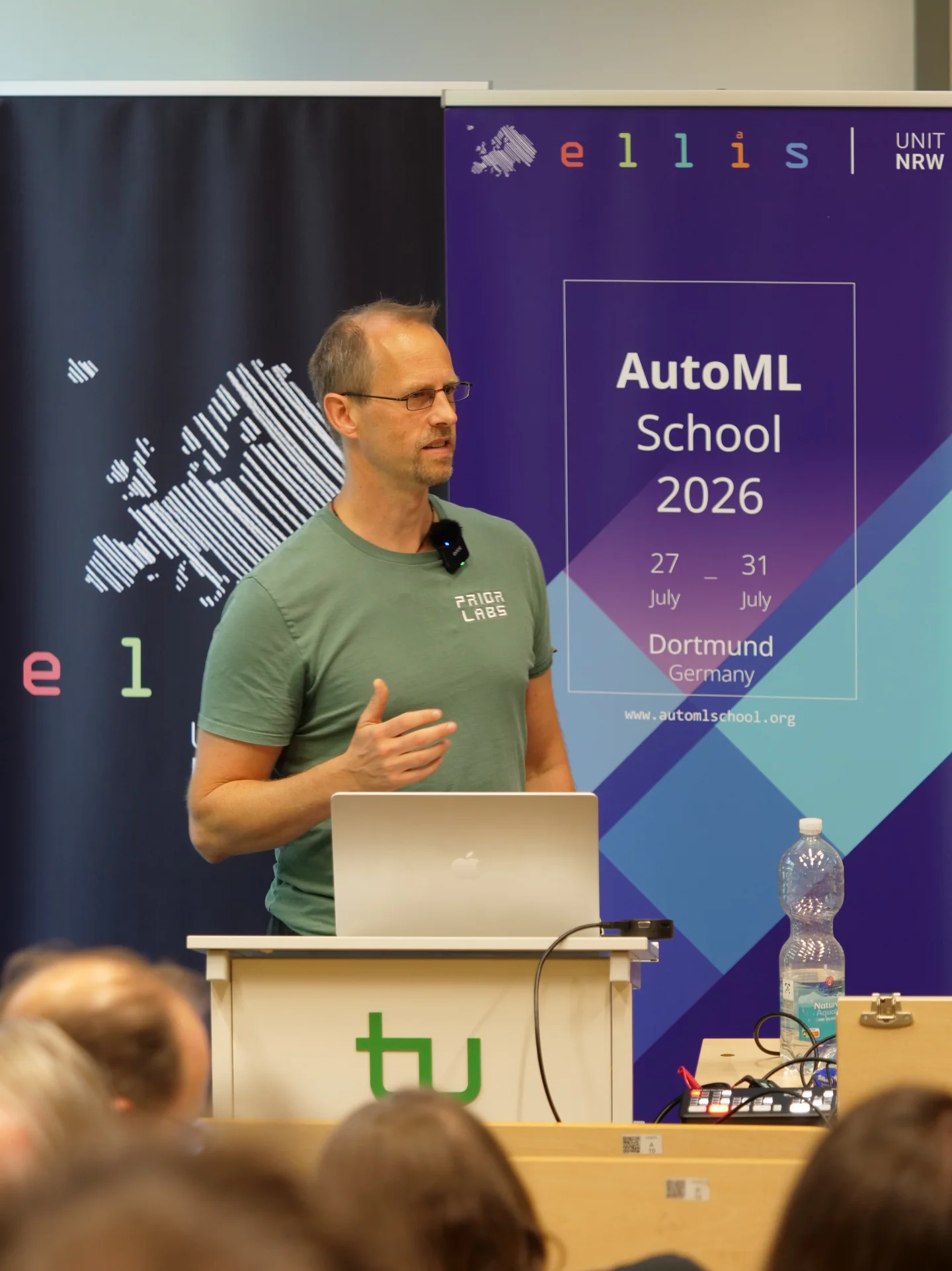
A highlight of the summer school was Frank Hutter’s keynote “The Foundation Model Revolution for Tabular Data”. The AutoML pioneer demonstrated how foundation models are beginning to transform machine learning on tabular data, a domain in which gradient-boosted decision trees and AutoML systems have long been dominant. In particular, he showed how such models can be applied to basically all tabular tasks with comparatively little task-specific adaptation, marking an important step in making machine learning available to everyone.
To ground AutoML in the real world, the summer school featured talks by Alexander Tornede from Beckhoff industries and Johannes Dürholt from Evonik. Alexander, who has intensively researched AutoML methods during his PhD and PostDoc in Paderborn and Hannover, gave insights about the messiness and often unknown constraints of real-world applications compared to easy, well-behaved academic benchmarks. Johannes showed how Evonik uses Bayesian optimization to improve experiment design for chemical processes. He introduced the open source BoFire library, one of their main tools, and also demonstrated how custom kernels for Gaussian processes improve the optimization process for liquid chromatography. His talk also illustrated that methodological and algorithmic innovations in AutoML do not only emerge from academic research labs, but also from solving concrete industrial problems.
Exchange Within (the AutoML) Community
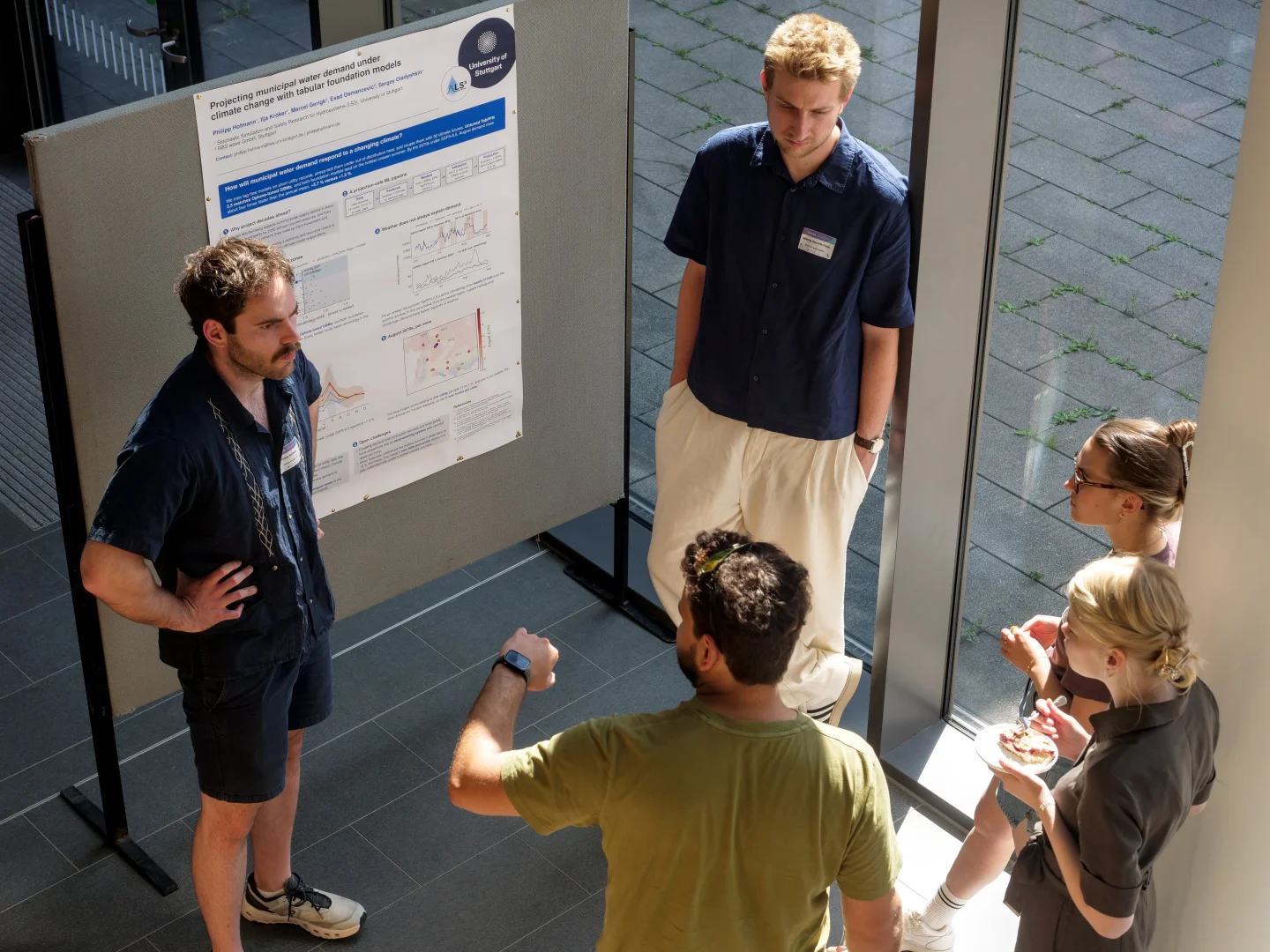
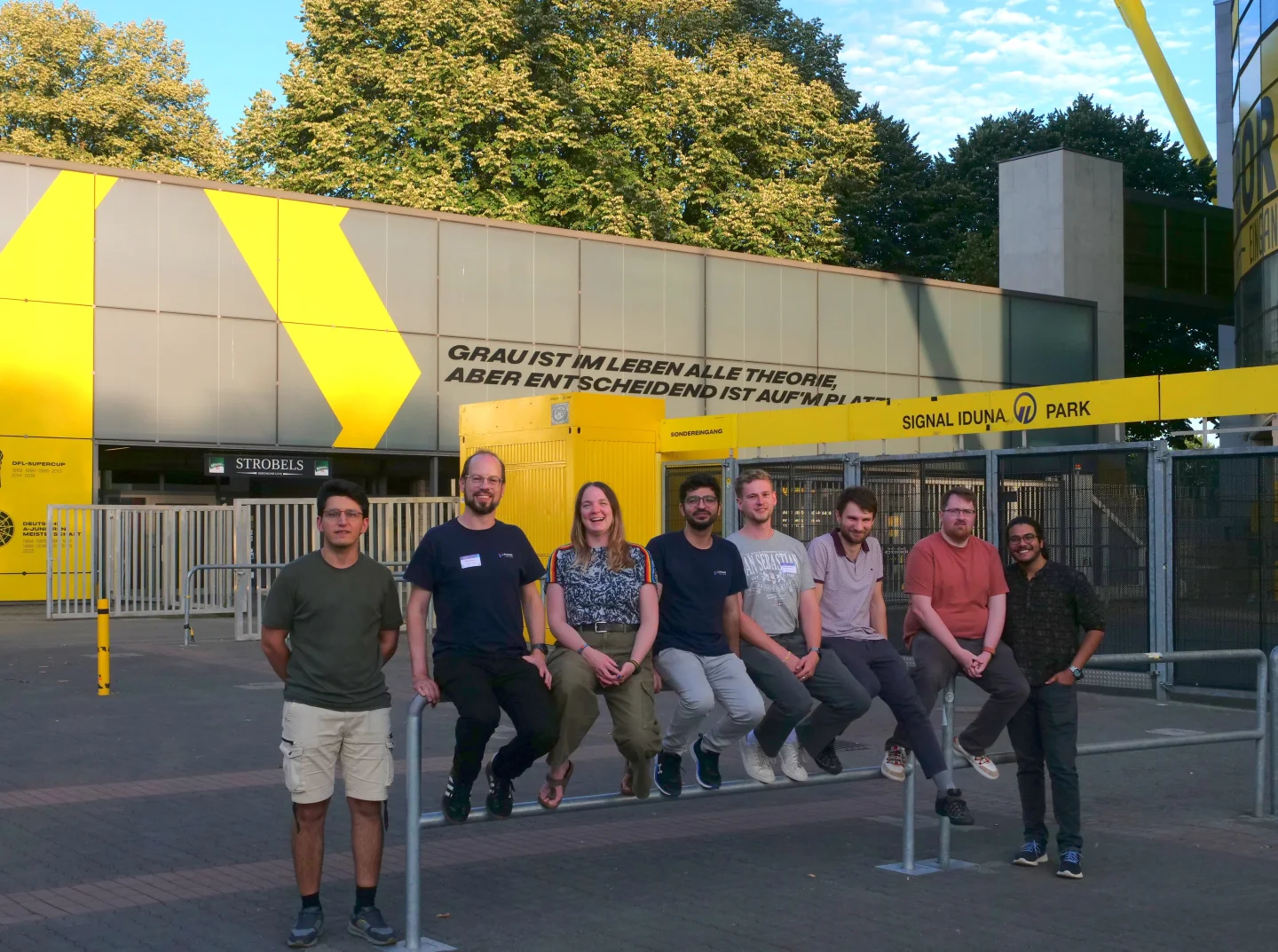
The summer school did not only consist of lectures, but was designed to maximize interaction between the participants and to build new connections within the AutoML community. A poster session gave participants the opportunity to discuss their current research with speakers and fellow attendees. The discussions did not end when leaving the university and participants met for the summer school dinner near Dortmund’s football stadium and joined a pub crawl that highlighted the city’s long history as a centre of brewing.
The AutoML School was very valuable to me because it gave me new perspectives that I can directly apply to my research in Neural Architecture Search. I also really appreciated the opportunity to learn from and exchange ideas with other researchers in the field.
Sergio Sarmiento-Rosales (Summer School Attendee)
First ELLIS Summer School of the newly founded ELLIS Unit NRW
The ELLIS Summer School on AutoML was the first event handled by the newly founded ELLIS Unit NRW and brought together unit members from Dortmund, Paderborn, Cologne and Bochum. Besides the participants it also brought together researchers from different ELLIS Units (Freiburg, Munich, Tübingen, NRW). To foster further collaboration, recordings of selected sessions will be made available at youtube.com/@automl_org.
The next AutoML Summer School will take place in Leiden in 2027. Updates will be posted on automlschool.org.
___________________________________
Image credits: Mykhailo Koshil
Website of the ELLIS Summer School on AutoML 2026: https://www.automlschool.org/home
The article was written by: