Unit Jena: ELLIS Summer Lecture Series - Explainability & Understanding of Models
The ELLIS Summer Lecture Series on “Explainability & Understanding of Models” brings together leading researchers to explore one of the most pressing challenges in modern AI: making complex machine learning systems transparent, interpretable, and trustworthy. As models grow in scale and impact, understanding how and why they make decisions becomes essential for scientific progress, real-world deployment, and societal acceptance. This lecture series offers cutting-edge insights into methods for explaining model behavior, uncovering internal representations, and bridging the gap between performance and interpretability—providing a platform for discussion, learning, and collaboration across the ELLIS community and beyond.
The lecture series is supported by the Professorinnenprogramm 2030 funded by the German federal and state governments as well as by the “Women in ELLIS” initiative. The Professorinnenprogramm 2030 promotes gender equality and supports the advancement of women in academia and research institutions across Germany. As part of the Professorinnenprogramm 2030, Friedrich Schiller University Jena received a positive evaluation of its gender equality concept by an independent review panel and was recognized as a “University with Strong Gender Equality” (“gleichstellungsstarke Hochschule”). “Women in ELLIS” highlights and connects leading female researchers in artificial intelligence and machine learning across Europe. Through lectures, mentoring, and networking activities, the initiative aims to strengthen diversity and female leadership in AI research.
TITLE
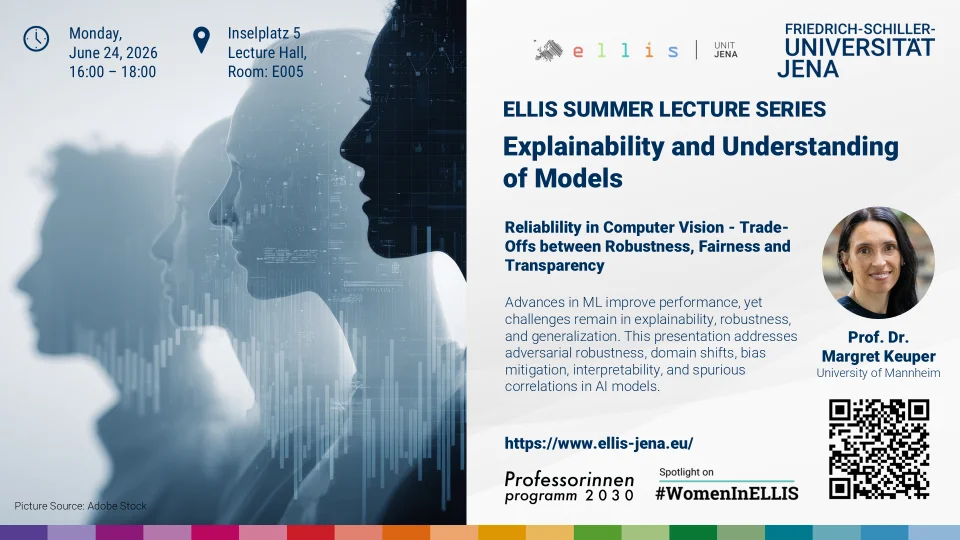
Reliablility in Computer Vision – Trade-Offs between Robustness, Fairness and Transparency
ABSTRACT
Over the past years, we have seen tremendous progress in machine learning techniques, partly due to an enormous growth in data resources, increased compute power and advances in methodology for specialized tasks. Despite the strong progress, there are several issues with current approaches. Not only do they rely on large amounts of annotated training data, but they also require the task to be explicitly defined at a fine-grained level and the learning architecture to be optimized specifically for this task. The resulting model usually has a very limited explainability and a low level of generalizability and robustness against domain shifts or adversarial examples. Yet, for many use-cases, these properties are crucial to allow for practical applicability. In this presentation, I will show samples from our recent work towards improving a model’s generalization ability and transparency, specifically (i) addressing robustness under adversarial attacks and domain shifts while not emphasizing class-wise biases, and (ii) addressing the relationship between inherent interpretability and spurious correlations.
BIO
Prof. Dr. Margret Keuper is a full professor for Machine Learning with focus on computer vision at the University of Mannheim. She is also an affiliated research leader at the Max Planck Institute for Informatics, Saarbrücken. Professor Keuper received her PhD degree from the University of Freiburg under the supervision of Prof Thomas Brox and worked as a postdoctoral researcher at the University of Freiburg working on topics related to motion estimation, segmentation, and grouping. Since 2024 Professor Keuper is a ELLIS Fellow and member of the ELLIS Unit Saarbrücken. See her #WomenInELLIS spotlight.